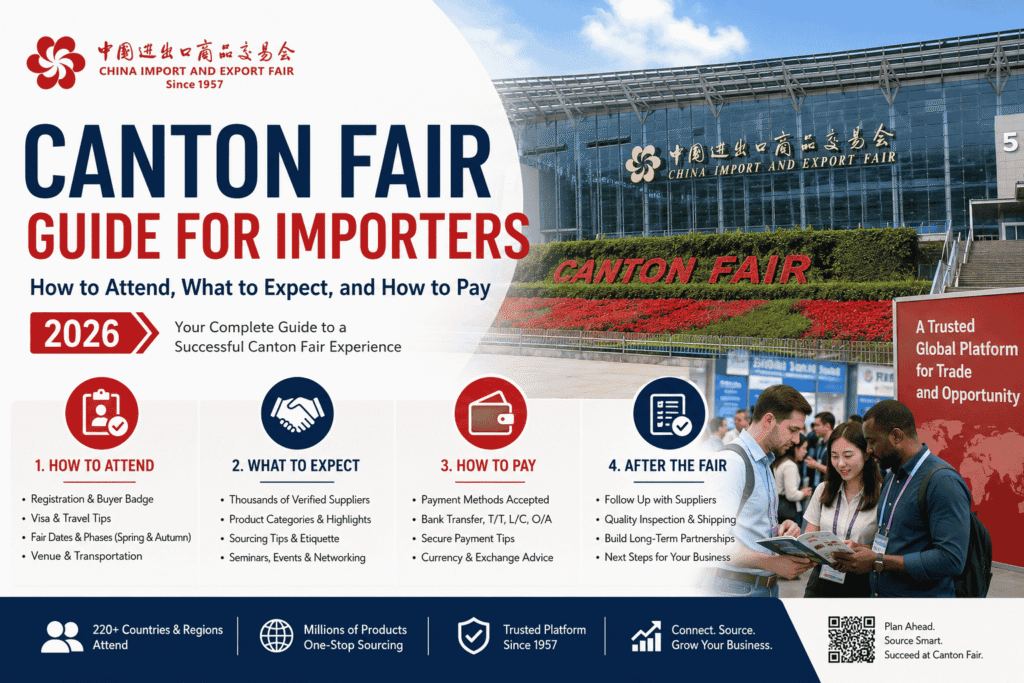
In April 1957, twelve countries sent representatives to a trade fair in Guangzhou that would become the longest-running and largest export trade fair in the world. Nearly seven decades later, the China Import and Export Fair — universally known as the Canton Fair — still convenes twice a year, still in Guangzhou, and still draws more foreign buyers than any comparable event on the planet. In 2024, over 246,000 foreign buyers attended across 215 countries and regions. Whatever China manufactures, the Canton Fair displays it first. This guide is the complete manual for any importer planning to attend.
1. What Is the Canton Fair? Essential Background
The Canton Fair runs twice annually, each time for 15 days divided into three five-day phases. Each phase focuses on different product categories, which means attending only one phase gives you access to roughly one-third of the fair’s exhibitors. Most serious buyers stay for multiple phases or return across two sessions.
Spring Session: Typically April 15 – May 5 (approximate dates — vary by year)
Autumn Session: Typically October 15 – November 4
The venue is the Canton Fair Complex (中国进出口商品交易会展馆) in Guangzhou’s Haizhu District — the world’s largest exhibition complex, spanning 1.1 million square metres of indoor exhibition space plus outdoor areas. It is a 30-minute metro ride from Guangzhou Baiyun International Airport (Line 3, Pazhou stop).
2. The Three Phases: Which One Should You Attend?
| Phase | Days | Product Categories |
|---|---|---|
| Phase 1 | Days 1–5 | Electronics, machinery, building materials, lighting, hardware, vehicles |
| Phase 2 | Days 6–10 | Consumer goods, gifts, home decorations, toys, holiday items, stationery, medicine/health |
| Phase 3 | Days 11–15 | Textiles, garments, shoes, office supplies, cases, bags, food products, chemicals |
Pakistani and Nigerian importers sourcing general merchandise (gifts, decorations, stationery) typically find Phase 2 most productive. Bangladeshi buyers focused on textiles and garments prioritise Phase 3. Electronics importers must be present for Phase 1. If budget allows, attending all three phases maximises exposure — many buyers structure their entire China sourcing trip around a Canton Fair week, combining the fair with side visits to Yiwu, Shenzhen electronics markets, or Guangzhou’s fabric district (Zhongda).
3. How to Register for the Canton Fair
Registration is free for buyers. The process:
Step 1 — Online pre-registration: Visit the official Canton Fair website (cantonfair.org.cn — the official URL, not third-party booking sites that charge fees). Register with your passport details, business name, and email. You will receive a confirmation email with a QR code.
Step 2 — Badge collection: Arrive at the Guangzhou Convention Bureau or accredited hotels to collect your physical badge, or use the QR code for direct entry at the venue. Badge collection locations expand each year; check current-year arrangements on the official site.
Step 3 — Visa to China: Most nationalities require a Chinese business visa (M visa) for Canton Fair attendance. Apply at your nearest Chinese embassy or consulate at least 3–4 weeks before your intended travel date. For eligible nationalities, visa-on-arrival or e-visa options may apply — check with your embassy. Some countries (Kazakhstan, Russia, many ASEAN nations) have visa-free agreements for short stays.
Important: Registration is for individual buyers only. Agency applications (attending on behalf of multiple companies) require separate corporate registration with different documentation requirements.
4. Accommodation in Guangzhou During Canton Fair
The Canton Fair’s twice-yearly occurrence drives Guangzhou hotel prices to extreme peaks. A room that costs ¥200/night off-season may reach ¥1,500–3,000 during fair weeks. Plan accommodation 2–3 months in advance — this is not an exaggeration.
Best areas to stay:
- Pazhou island (venue area): Walking distance to the complex. Very expensive but eliminates commute
- Tianhe District (city centre): 30–45 minutes by metro. Better price-to-quality ratio. Metro Line 3 connects directly to the Pazhou venue
- Foshan (adjacent city): Budget option for mid-range importers. 45–60 minutes by metro/taxi. Significantly cheaper hotels; Foshan itself has a large furniture market worth visiting
Book official fair hotels through the Canton Fair’s official hotel booking system for guaranteed transportation links. Third-party bookings work fine for non-official hotels.
5. Payment Methods at Canton Fair: What You Can Use
Understanding payment options at the fair prevents the common frustration of arriving prepared to buy and finding your payment method unsupported:
Alipay and WeChat Pay (foreign card-linked): Accepted at most exhibitor booths with QR codes. For sample purchases and small orders paid on-site, these work seamlessly up to your account limits. Load sufficient balance before entering the venue.
Cash RMB: Bank of China and ICBC have service counters within or adjacent to the Canton Fair Complex. Currency exchange available for major currencies. Bring your passport. Lines are long during peak fair days — exchange your cash the evening before your buying day.
Credit cards (Visa/Mastercard): Accepted at official fair cafeterias, some larger exhibition stands, and all hotels near the venue. Many individual booth exhibitors do not have card terminals — do not rely on this for purchasing.
Bank transfer for larger orders: The vast majority of Canton Fair orders are not paid on the spot. Buyers collect samples, negotiate prices, exchange business cards (or WeChat contacts), and confirm orders by bank transfer (T/T) after returning home. The fair is primarily a sampling and relationship-building event; payment follows separately via international wire.
Alibaba Trade Assurance: Many Canton Fair exhibitors are Alibaba verified suppliers. For post-fair orders, using Alibaba Trade Assurance provides escrow protection — money released to supplier only after you confirm receipt and quality. This is the recommended payment channel for first-order relationships formed at the fair.
6. Negotiating at Canton Fair: What You Need to Know
Canton Fair exhibitors are seasoned in dealing with international buyers. Negotiation dynamics differ slightly from Yiwu’s wholesale market environment:
Price lists are starting points. Like Yiwu, initial prices build in negotiation margin. However, many Canton Fair suppliers deal with institutional buyers and have less flexibility on small orders. Your negotiating power scales with order size.
Collect information, negotiate later. The noise, size, and time pressure of the fair is not conducive to the best negotiating conditions. Experienced buyers collect samples, take notes, photograph product details and price lists, exchange contacts, then follow up in calmer email or WeChat conversations after returning home.
Request samples explicitly. Most exhibitors will not give away their display samples freely. Ask clearly: “Can I purchase a sample? What is the sample price?” — paying a reasonable sample price is normal. Carrying samples home is subject to your country’s customs rules on commercial samples.
English is widely spoken. The Canton Fair attracts enough international buyers that most medium-to-large exhibitors have English-speaking staff. Translation apps (Google Translate, WeChat translation feature) cover the gaps for smaller booths.
7. Digital Canton Fair: The Online Alternative
Since 2020, the Canton Fair has maintained an online platform (online.cantonfair.org.cn) that allows buyers who cannot attend in person to browse exhibitor catalogues, contact suppliers, and negotiate digitally. The online fair runs concurrently with the physical event.
The online platform is a useful research and pre-qualification tool but does not replicate the sample-handling, relationship-building, and price-negotiating power of physical attendance. Use it to shortlist suppliers and prepare your visit agenda rather than as a substitute for physical attendance.
8. Practical Tips for First-Time Attendees
- Wear comfortable shoes: You will walk 15,000–25,000 steps per day across hard exhibition hall floors. Foot pain ends buying days prematurely — this is not a trivial consideration
- Bring business cards: Chinese business custom still values physical business card exchange. Carry at least 200 cards for a multi-phase visit
- Download the official Canton Fair app: It has a searchable exhibitor database with hall maps, booth numbers, and contact details
- Pre-schedule key meetings: Contact your most important target suppliers before the fair and arrange specific meeting times. Showing up at a booth of a major supplier unannounced on a peak day often means waiting or missing the decision-maker
- Note booth addresses precisely: The same format as Yiwu — hall number, floor, aisle, booth number. A photo of the booth address card is faster than writing it down
- Hydrate and eat: The fair complex has food courts and cafes, but queues are long during peak hours. Carry water and snacks to maintain energy through afternoon sessions
Frequently Asked Questions
Q: Is the Canton Fair free to attend?
A: Buyer attendance is free. There is no admission charge for registered buyers. Only exhibitors pay for booth space.
Q: Can I bring my interpreter/agent to the Canton Fair?
A: Yes. Registered buyers can bring assistants registered under the same company. Independent agents can register separately as buyers if they have their own business credentials.
Q: How do I know if a Canton Fair exhibitor is legitimate?
A: All exhibitors are vetted by the fair organisers and are registered Chinese export companies. However, “legitimate exhibitor” does not guarantee product quality or post-fair supply reliability. Always conduct independent due diligence — check Alibaba ratings, request trade references, and use Trade Assurance for first orders.
Q: What is the best way to handle the physical catalogue and samples I collect?
A: Ship samples home via DHL/FedEx/EMS from the venue’s shipping service counter rather than carrying everything in your luggage. The fair complex has courier desks specifically for this purpose. Catalogues can be photographed rather than carried — your phone camera is your most important tool.
Conclusion: The Canton Fair Is Still the World’s Best Sourcing Event
In an era when Alibaba’s online platforms promise the same suppliers with less airfare, the Canton Fair’s persistent attendance figures deliver a clear verdict: face-to-face sourcing at scale remains irreplaceable for serious importers. The ability to handle products, read manufacturing capabilities from booth quality, observe the supplier’s team, negotiate in real time, and build relationships that survive the first transaction — none of this is replicated by a browser tab. The Canton Fair, 67 years on from its first edition, remains the most efficient use of a sourcing trip to China. Prepare thoroughly, arrive rested, and buy intelligently. The market rewards preparation above everything else.