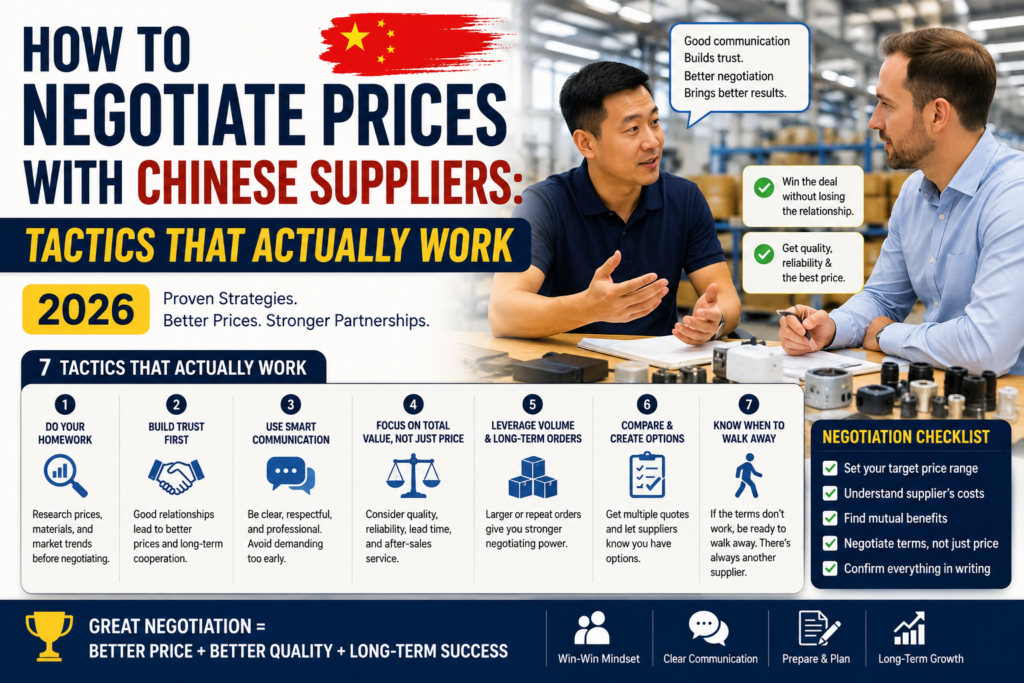
An experienced Guangzhou trading company manager once described his assessment of foreign buyers in twelve words: “The ones who never negotiate are the ones we never call back.” His meaning was precise: in Chinese supplier relationships, negotiation is not a confrontation to be avoided — it is a signal of seriousness, a demonstration of market knowledge, and a prerequisite for the long-term pricing that defines a profitable import business. The foreign buyer who accepts the first quote without response is leaving margin on the table and, counterintuitively, undermining the supplier’s respect for the relationship. This guide provides the tactics, scripts, and cultural context needed to negotiate effectively with Chinese suppliers.
1. Understanding Why Negotiation Is Expected
Chinese manufacturing and trading culture operates on an explicit expectation of price negotiation. First quotes for foreign buyers typically build in a margin of 20–40% above the supplier’s floor price. This is not deception — it is the standard operating procedure for a first business interaction, equivalent to asking a higher rental price when listing a property.
Several structural factors drive this practice:
Information asymmetry: The supplier knows their cost structure; you do not. Their opening offer probes what you know about market prices. A buyer who counters with a specific, researched number signals market knowledge. A buyer who accepts or counters with a vague “can you do cheaper?” signals unfamiliarity.
Relationship investment: Suppliers allocate their best attention, fastest lead times, and proactive quality monitoring to buyers they respect as long-term partners. A buyer who demonstrates commercial sophistication — which negotiation signals — is prioritised over one who appears to be placing a one-off order.
Margin structure: Chinese factories operate on thin net margins (often 5–15% for manufacturing, higher for trading companies). The initial quote buffer covers the supplier’s uncertainty about your true order volume, reliability, and duration as a customer. Demonstrating long-term commitment justifies the supplier reducing their risk premium.
2. Do Your Research First: The Non-Negotiable Prerequisite
Effective negotiation begins before you contact a supplier. Entering a price conversation without market data is like negotiating a salary without knowing the industry average — you will either leave money on the table or make unrealistic demands that damage the relationship.
Quote three to five suppliers simultaneously. This is the single most important preparatory step. Sending identical RFQs (Request for Quotation) to five suppliers immediately gives you a market price range. The spread is often revealing — a supplier quoting 40% above the median is telling you something about their pricing strategy.
Search 1688.com for the same product. The domestic Chinese wholesale price for your product category provides a floor benchmark. If 1688 shows similar items at ¥18/unit and your supplier quotes USD 4/unit (~¥29), you have clear evidence that margin exists.
Use Alibaba’s “Price Trends” and similar buyers’ guides. Some categories have transparent price history tools. Historical data prevents you from negotiating against an unusually low price caused by temporary raw material depression.
3. The Core Negotiation Scripts
These scripts are designed for written communication (email or WeChat message) — the medium most China sourcing negotiations occur in:
Script 1 — The Competitor Reference:
“Thank you for your quotation. I am currently evaluating three suppliers for this product. Another supplier has quoted [X]% lower for similar specifications. If you can match their price, I would prefer to work with your company as you have a stronger quality rating. Can you review your pricing?”
Why it works: Creates competition without confrontation. Gives the supplier an honourable reason to reduce their price (matching competition) rather than admitting they were overcharging.
Script 2 — The Volume Commitment:
“Our initial order will be [X units], but if quality meets expectations, we plan to order [5X units] per quarter. For our long-term partnership pricing, can you offer [target price] per unit? This would help us commit to you as our primary supplier.”
Why it works: Shifts the conversation from a single transaction to a long-term relationship. Suppliers price based on expected lifetime value, not single-order economics. A credible volume commitment justifies a meaningfully lower per-unit price.
Script 3 — The Specification Adjustment:
“Your current quote is slightly above our target price. Can we discuss which components could be adjusted to reduce cost while maintaining the essential quality? For example, could we use [alternative material] for the packaging, or reduce to [X] colour options? I want to find a way for us to work together.”
Why it works: Gives the supplier a face-saving path to reduce price without simply conceding margin — instead, they adjust the product. This also produces a genuine cost reduction rather than margin compression, which leads to better quality maintenance.
4. Cultural Considerations That Change the Dynamics
Face (面子, miànzi): This concept — roughly translating to “dignity” or “social standing” — governs Chinese business interactions profoundly. Never make a supplier feel embarrassed or cornered in front of their colleagues or in public WeChat conversations. Private messages allow concessions that public channels do not. A supplier who feels their face is threatened will become defensive and less flexible, even if your price demand is objectively reasonable.
Relationship before transaction (关系, guānxi): Building a personal relationship with your supplier contact precedes efficient commercial negotiation. Brief social conversations before business discussions — asking about their city, their factory’s capacity, their product expertise — create the relational foundation that makes negotiation feel collaborative rather than adversarial.
Patience as a negotiating tactic: Chinese negotiators are culturally conditioned for longer decision timescales than Western buyers. If you indicate urgency (“I need to decide today”), you hand the supplier a significant advantage. Patience communicates options — that you are not dependent on this particular supplier.
Directness on specifics, indirect on rejection: Be specific about your target price, quantity, and timeline — Chinese suppliers appreciate precision. But frame rejections of offers as “not currently possible” rather than “no” — preserving optionality for both sides.
5. Negotiating via WeChat vs Email
Most China sourcing negotiations in 2026 occur primarily via WeChat, with formal confirmations followed up by email. Understanding the medium’s effect on negotiation:
WeChat advantages: Faster response times; voice messages allow more nuanced tone than text; video calls build personal rapport; Chinese suppliers are more comfortable and responsive on WeChat than email.
WeChat limitations: Less permanent record than email for formal commitments; negotiations that start on WeChat should be confirmed by email for important price agreements.
Hybrid approach: Use WeChat for initial contact, rapport building, and exploratory price discussions. Confirm final agreed prices, specifications, and payment terms via email with a formal quote document. This gives you the speed and warmth of WeChat with the legal clarity of documented correspondence.
6. What to Negotiate Beyond Price
Price is the most visible negotiation variable but not the only one worth targeting:
- Minimum order quantity (MOQ): Negotiate down, particularly for first orders. A supplier quoting 1,000-unit MOQ may accept 500 for a first order if you commit to 2,000 on the second
- Payment terms: Standard is 30% deposit, 70% before shipment. For established relationships, 20/80 or even 10/90 terms reduce your cash commitment. Net-30 after delivery is achievable with long-standing partners
- Lead time: Priority production scheduling for rush orders; confirmed ship-by dates with penalties for delay
- Free samples: For reorders, free sample sets are standard to request — you should not be paying for samples after the first order
- Packaging upgrades: Retail-ready packaging, additional languages on labels, or custom inserts often cost less than quoted when part of a bundle negotiation
7. Common Mistakes to Avoid
- Negotiating aggressively on the first contact: Start with relationship building, not price pressure. A cold first message demanding a 30% reduction signals inexperience and alienates good suppliers
- Revealing your maximum budget: “I can spend up to $3 per unit” is a ceiling that will immediately become the floor. State your target price, not your maximum
- Accepting the first counter-offer: Suppliers factor in at least one more negotiating round. Accepting the first counter leaves money unretrieved
- Negotiating on samples order: Sample pricing is not wholesale pricing. Negotiate the bulk order price separately — samples are for quality assessment, not price benchmarking
- Ignoring non-price terms: A supplier who cannot commit to a lead time or quality standard at a negotiated price is more expensive than one who holds firm on price but delivers reliably
Frequently Asked Questions
Q: How much can I realistically negotiate down from the first quote?
A: For a foreign buyer placing a first order, 10–20% is typically achievable. For a returning buyer with a track record and volume commitment, 15–30% below initial quote is realistic. Beyond 30% from the first quote usually signals either unrealistic expectations or a product category with unusually high initial markup.
Q: Should I tell a supplier I am comparing them to competitors?
A: Yes — diplomatically. “I am evaluating a few suppliers” is standard and creates healthy competitive pressure without being hostile. Specific competitor name-dropping (“Factory X quoted me Y”) works best when you have real competing quotes.
Q: What if the supplier stops responding after I negotiate?
A: Some suppliers disengage from buyers they perceive as too price-focused or unrealistic. Wait 3–5 days and follow up warmly. If still no response, the supplier has effectively self-selected out — which saves you from a difficult long-term relationship. Move to your next shortlisted supplier.
Conclusion: The Best Negotiation Feels Like Collaboration
The most effective supplier negotiations in China are ones where, at the end, both parties feel they have arrived at a reasonable deal for a relationship they intend to maintain. The Guangzhou manager who values buyers who negotiate is not celebrating aggression — he is celebrating commitment. A buyer who understands market prices, articulates their needs precisely, respects the supplier’s constraints, and returns quarter after quarter is the customer every Chinese factory wants. Negotiation, done correctly, is the opening argument for that long-term relationship. Make it well, and the price discussion is just the beginning of something profitable for both sides.