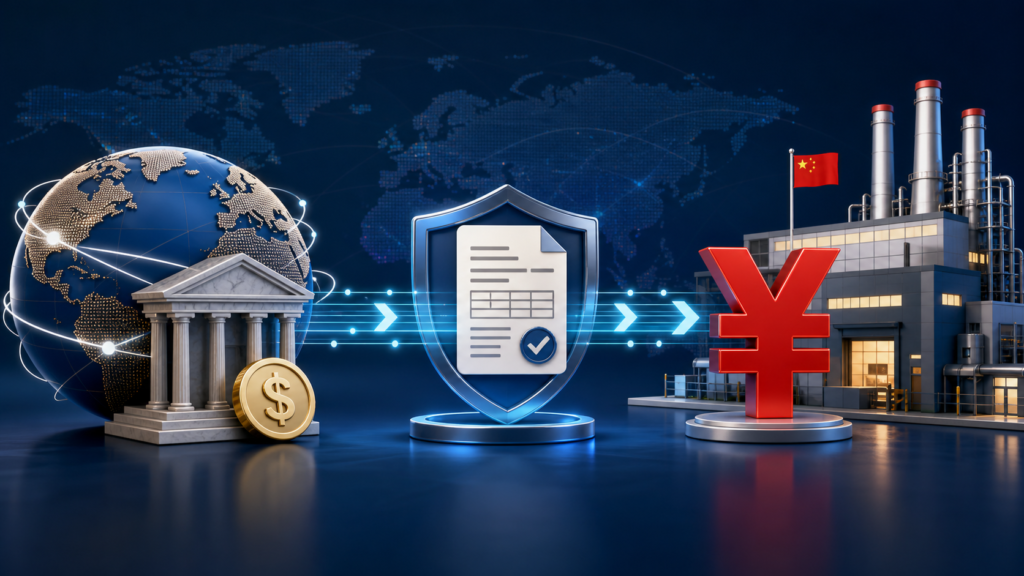
Foreign buyers can pay Chinese suppliers in RMB without opening a Chinese bank account. The main options are a cross-border business payment provider that supports CNY or CNH, a bank wire in the invoice currency, or the protected checkout offered by a sourcing marketplace. The best route depends on the supplier’s legal name, invoice currency, bank account, platform, and the records you need if a dispute occurs.
Start with the contract and pro forma invoice—not with an exchange app. Confirm exactly who is selling the goods, who owns the receiving account, and whether the invoice is denominated in CNY, CNH, USD, or another currency. A payment that contradicts those documents can be delayed, returned, or difficult to recover.
Best general rule: pay the company named on the contract and invoice into an account owned by that company. If a supplier requests a personal account, unrelated company, crypto wallet, or last-minute beneficiary change, pause and verify independently.
What should you confirm before sending RMB to China?
- Legal supplier name: obtain the Chinese company name and Unified Social Credit Code shown on its business licence.
- Account ownership: make sure the bank-account beneficiary matches the contracting company unless a documented, legitimate collection arrangement explains the difference.
- Invoice currency: do not send CNY against a USD invoice without written agreement. Wise, for example, tells customers to send USD when the contract and invoice are in USD.
- Payment milestone: connect the deposit and balance to defined production, inspection, and shipment terms.
- Refund route: ask where a refund would be sent and who bears conversion or bank charges.
- Verification channel: confirm new or changed payment details through a known phone number or video call, not only the email or chat message containing the change.
Use our separate Chinese supplier-payment scam checklist before the first transfer, and verify the supplier itself rather than treating bank details as proof of legitimacy.
Ways to pay a Chinese supplier from overseas
| Route | Best fit | Main advantage | Main limitation |
|---|---|---|---|
| Business payment provider with pay-to-China support | Documented supplier invoices and repeat purchasing | May convert your USD or other balance and deliver CNY, CNH, or USD | Country, business, currency, industry, and beneficiary eligibility vary |
| International bank wire | Established supplier relationships and larger invoices | Widely understood, traceable bank-to-bank record | FX spread, intermediary fees, slower investigation and limited purchase protection |
| Marketplace protected checkout | Orders made through Alibaba.com or another platform with genuine protection | Payment remains connected to the platform order and dispute process | Only protects transactions that follow the platform’s rules and payment flow |
| 1688 authorised payment route | Foreign buyers purchasing through 1688 | Designed for a platform that normally does not accept ordinary international cards | Availability and supported markets must be checked in the live product |
| Personal wallet or unrelated account | No default business use case | May look convenient | Weak beneficiary match, documentation and recovery position |
Should you pay the supplier in CNY, CNH, or USD?
CNY is onshore renminbi used in mainland China. CNH is the market convention for offshore renminbi. Both are RMB, but they trade in different markets. USD remains common in export contracts.
- Pay CNY when the supplier quotes and invoices in CNY and your provider supports a documented CNY business-payment route.
- Pay CNH when the supplier has an eligible offshore or supported account and the contract uses CNH.
- Pay USD when the contract and invoice are in USD or the supplier’s export collection process is built around USD.
Do not assume a CNY quote is automatically cheaper. Ask for comparable written prices in the currencies the supplier will accept, then calculate the amount expected to arrive after exchange-rate spread and all transfer fees. Our RMB versus USD guide explains how to compare the effective conversion cost.
How does a pay-to-China provider work?
In an eligible route, you fund a regulated business-payment account in USD or another supported currency, add the Chinese supplier, provide the order or invoice evidence, obtain any required CNY payment quota, and instruct payment to the verified beneficiary.
WorldFirst’s current “Pay CNY to China” instructions require supplier information and proof of the underlying trade order. For a company supplier, the requested information includes its Chinese company name and Unified Social Credit Code. Its supported funding currencies and limits depend on the regional product, so use the documentation for your own account region rather than copying a limit from another country.
Wise states that eligible Business customers can send CNY to a mainland-China business recipient’s CNY business account. It asks for the beneficiary, bank, address, and payment-purpose information, and warns that the recipient bank may request the contract and invoice.
How do you pay by international bank wire?
- Obtain a signed contract or accepted order and matching invoice.
- Collect the beneficiary’s exact legal name, account number, bank name and address, and SWIFT/BIC.
- Verify the details independently with the supplier.
- Choose the same currency stated on the invoice unless both parties amend it in writing.
- Enter a truthful commercial payment purpose and invoice reference.
- Review the sender, intermediary, and recipient charge arrangement.
- Send a small test payment when appropriate for a new beneficiary, then confirm receipt before sending the balance.
- Retain the transfer confirmation and reconcile it against the purchase order.
A SWIFT message proves that a payment instruction moved through banks; it does not provide escrow or prove that the supplier will deliver. Your commercial controls—supplier verification, contract, inspection, shipment documents, and staged payments—remain essential.
What about Alibaba.com and 1688?
Alibaba.com says Trade Assurance orders should be paid through the platform and warns buyers not to pay outside it. Its official flow supports methods including cards, digital wallets, and bank-to-bank transfers using the bank information supplied by Alibaba.com. Protection depends on the order and platform terms, so the supplier’s private payment request is not equivalent.
For 1688, use an authorised checkout or payment solution available to your account and country. Our guides explain how foreigners can pay on 1688 and how to assess 1688 suppliers. Keep the platform order, payment, and supplier identity connected.
Supplier-payment red flags
- The beneficiary changes after the invoice is issued.
- The supplier asks you to label a commercial payment as a gift, loan, or family transfer.
- The account belongs to an employee, friend, agent, or unrelated company without a verifiable written collection agreement.
- The supplier moves an Alibaba.com protected order off-platform.
- You are pressured to pay the entire balance before inspection or agreed evidence.
- The supplier requests USDT, an underground exchange, or a personal Alipay/WeChat wallet to “avoid tax” or “save paperwork.”
If crypto is proposed, read our USDT-to-Alipay legal-risk guide before proceeding. It explains why a third-party fiat settlement is not a direct Alipay transfer.
Frequently asked questions
Can a foreign company send CNY directly to a mainland supplier?
Yes, through an eligible bank or regulated business-payment route that supports CNY to the supplier’s account and the underlying trade. Availability depends on the sender’s country, provider, business type, beneficiary, and documentation.
Is paying in RMB always cheaper than paying in USD?
No. Compare the supplier’s written prices, your provider’s exchange rate, all fees, refund implications, and which party otherwise bears the currency risk.
Can I pay a factory’s personal Alipay account?
Do not treat it as the default for a factory invoice. Ask why the legal seller and beneficiary differ, obtain documentary support, and assess the accounting, recovery, tax, and fraud consequences.
Sources and review notes
- Wise Help Centre: sending CNY to mainland-China business recipients.
- WorldFirst: Pay CNY to China process and trade-document requirements.
- Alibaba.com: Trade Assurance payment flow and on-platform payment warning.
- SWIFT: cross-border CNY transaction message guidelines.
Written by the Extentage editorial team. Fact-checked against the sources above on 2 August 2026. Provider coverage, fees, limits, and onboarding requirements vary by region and can change; verify the live quote and terms before paying.