A first-time importer, advised by a YouTube video to “just source from China directly,” opens a browser, types in “China wholesale website,” and finds herself simultaneously looking at two platforms that appear to be doing the same thing: 1688.com and Taobao.com. Both are owned by Alibaba. Both are in Chinese. Both are selling products at prices dramatically below anything available through Western distributors. And yet experienced importers treat them as entirely different instruments — going to one for certain product types and certain quantities, and to the other for entirely different purposes. The distinction matters because getting it wrong means either paying retail prices for wholesale volumes, or attempting to buy wholesale quantities of a product designed for individual consumers and discovering that minimum orders, logistics arrangements, and supplier communication norms are completely different from what was expected.
This guide resolves the 1688 versus Taobao question definitively for international buyers sourcing from China in 2026. It explains the architectural difference between the two platforms, the customer types each serves, the pricing structures that result, the payment methods available to foreign buyers, and the scenarios in which each is the appropriate choice. The argument throughout is that 1688 and Taobao are not alternatives but complements — they occupy different positions in China’s commercial ecosystem, and knowing where each fits prevents both overpaying and mismatched expectations.
1. The Fundamental Difference: B2B vs B2C
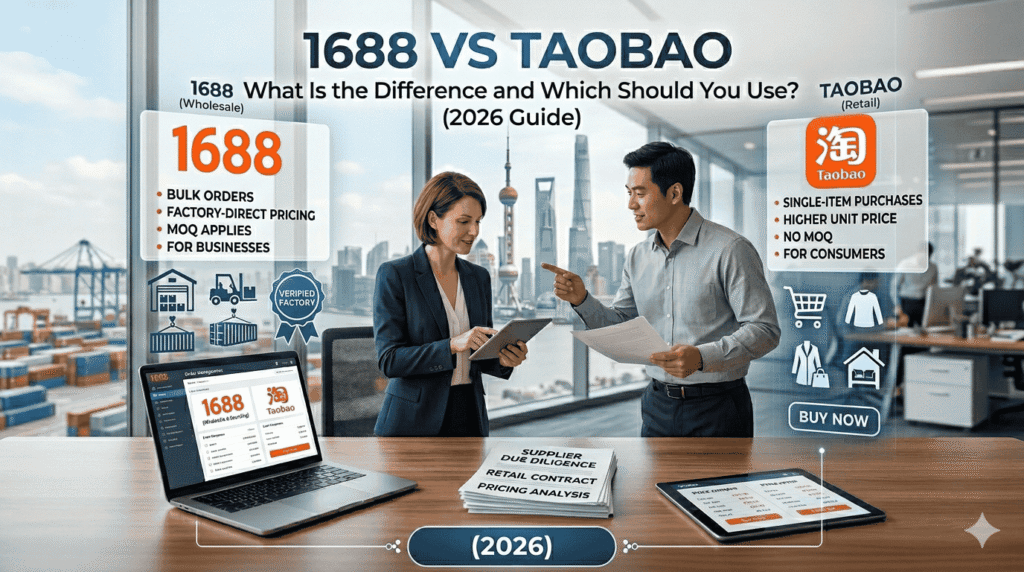
1688.com is China’s largest domestic B2B (business-to-business) wholesale marketplace. It is designed for manufacturers, factories, and distributors to sell in bulk to other businesses — primarily Chinese retailers, wholesalers, and increasingly, international importers. The name “1688” derives from the Mandarin phrase “一路发发” (yī lù fā fā), meaning “prosper all the way” — the numbers 1, 6, 8, 8 chosen for their auspicious sound in Chinese. Products on 1688 are priced at manufacturer or wholesale level; buyers are expected to purchase in minimum order quantities (MOQ) that may range from one piece to thousands depending on the product category; and the platform’s documentation, language, and payment infrastructure is entirely Chinese-oriented.
Taobao.com is China’s largest domestic B2C (business-to-consumer) retail marketplace. Its closest Western equivalent is eBay — individual merchants and small businesses sell individual items, usually with no minimum order requirement, to Chinese consumers. Prices on Taobao reflect retail margins rather than wholesale or manufacturer pricing. The platform is designed for individual shopping convenience: detailed product photos, consumer reviews, courier delivery to home addresses, and Alipay buyer protection escrow.
The same physical product — a set of ceramic mugs from a Jingdezhen factory, for example — appears on both platforms at vastly different prices and in different volume configurations. On 1688, the factory sells the mugs in MOQs of 100 pieces at a manufacturing cost price of RMB 12 per unit. On Taobao, a retailer who bought those mugs from the same factory sells them individually at RMB 28–35 each with free domestic shipping. The product is identical. The price difference reflects the distribution cost, retail margin, and convenience premium of the Taobao model versus the direct manufacturing cost of the 1688 channel.
2. Pricing Comparison
1688 prices are typically 40–70 percent lower than equivalent Taobao prices for the same product category, when adjusted for volume. The exact discount depends on the product category, the MOQ, and the specific seller. Categories with high manufacturing volume and standardised specifications (garments, electronics accessories, packaging materials) show the most dramatic price differences between platforms. Categories with artisan or handcraft elements may show smaller differentials.
The 1688 price advantage is only fully realised when the buyer meets the MOQ requirement. A buyer who wants 20 units of a product with an MOQ of 50 on 1688 is not getting the wholesale price benefit — they are either negotiating with the supplier to reduce the MOQ (possible but requires supplier cooperation) or effectively paying more per unit than the listed price suggests by ordering excess inventory they do not immediately need. Taobao, with its one-piece minimum order, is the more practical choice for genuine small-quantity purchasing, even though the per-unit price is higher.
3. Product Range and Categories
1688 excels in: raw materials, semi-finished goods, manufacturer-spec products, packaging, labelling, promotional items, generic consumer electronics components, garment fabrics and accessories, industrial supplies, and any product category where the buyer intends to resell, manufacture further, or package under their own brand. If the buyer is thinking like a business — “what is the factory gate price for this at sufficient volume?” — 1688 is the right platform.
Taobao excels in: finished consumer products for personal use, one-off sample purchases before committing to wholesale, niche or specialist items where the commercial volume is low, vintage or secondhand goods, and any category where consumer convenience infrastructure (detailed reviews, easy returns, individual item packaging) adds genuine value. If the buyer is thinking like a consumer — “I want one of this specific item delivered to a Chinese address” — Taobao is the right platform.
4. Payment Methods for Foreign Buyers
1688 payment for foreigners is the more complex challenge. 1688 is designed for domestic Chinese B2B buyers who pay via Alipay business accounts or corporate bank transfer. Foreign buyers without a Chinese bank account or fully verified Alipay account face significant friction. The primary solutions for international buyers are: using a Chinese Alipay account (requiring a Chinese bank account and full verification) for direct purchase, using a 1688 buying agent who handles payment on behalf of the foreign buyer, or using 1688’s International Edition (world.1688.com) which supports some international payment methods but has a smaller product selection than the domestic platform. The companion guide on paying on 1688 without a Chinese bank card on this site addresses this in detail.
Taobao payment for foreigners is more accessible but still China-centric. Taobao accepts Alipay as its primary payment method. Foreign buyers with a semi-verified Alipay account (passport-verified with a foreign card linked) can purchase on Taobao for delivery to a Chinese address. International delivery from Taobao is not natively supported — foreign buyers typically use a Chinese forwarding address or a Taobao buying agent for international delivery.
5. Supplier Communication and Trust
1688 suppliers communicate primarily through Alibaba’s internal messaging system (Aliwangwang) in Chinese. Building a productive dialogue with a 1688 supplier requires either Chinese language capability, a translation app used patiently, or a buying agent intermediary. Supplier responsiveness on 1688 varies — factory-direct sellers may not prioritise small international inquiries during busy production periods.
Taobao sellers are consumer-oriented and typically respond quickly to inquiries, but their communication capability in English is often limited. WeChat contact is commonly offered by Taobao sellers for follow-up communication. For quick, simple one-unit purchases, Taobao’s standard messaging interface is sufficient; for complex specification discussions, WeChat is more practical.
6. Quick Comparison
| Feature | 1688 | Taobao |
|---|---|---|
| Primary model | B2B wholesale | B2C retail |
| Price level | Factory/wholesale (40–70% below Taobao) | Retail/consumer |
| Minimum order | MOQ (varies by product, often 10–500 units) | 1 piece |
| Primary buyer | Businesses, importers, wholesalers | Individual consumers |
| Payment for foreigners | Complex — requires agent or verified Alipay | Easier — semi-verified Alipay |
| International delivery | Via freight forwarder or agent | Via forwarding address or agent |
| Private label capability | Yes — factory communication for custom specs | Limited — mostly finished products |
| Quality verification | Factory audit/sample before bulk order | Consumer reviews, Alipay buyer protection |
Conclusion
1688 and Taobao serve different buyers at different stages of the China sourcing journey. The established importer buying in volume, seeking factory-direct prices and private-label capability, belongs on 1688 — where the prices justify the complexity and the product range reflects China’s manufacturing output rather than its retail markup. The buyer who needs one sample, one item for personal use, or a finished product without minimum order constraints belongs on Taobao — where the infrastructure is built for exactly that use case, even if the unit economics are less attractive. Many experienced importers use both simultaneously: Taobao for samples and quality benchmarking, 1688 for production orders once the specification is confirmed. That workflow extracts the best of what each platform offers and avoids the frustration of applying the wrong tool to the wrong task.