In February 2022, a skier from Norway at the Beijing Winter Olympics purchased a bowl of dumplings at a venue restaurant using a digital wallet on her phone. The transaction took seconds, required no credit card, no exchange counter, and no Alipay account — just a wallet pre-loaded at an Olympic venue kiosk. What she used was the Digital Yuan, China’s central bank digital currency (CBDC), and she had become part of one of the most significant monetary experiments in modern financial history: the world’s first large-scale deployment of a sovereign digital currency by a major economy. The technology that served her dumpling transaction was the same technology that China is quietly integrating into the infrastructure of daily commerce, government services, and cross-border trade — and understanding it is increasingly relevant for any foreigner who engages with China’s financial system.
This guide explains what the Digital Yuan is, how it works technically and practically, how it differs from Alipay and WeChat Pay, what foreigners can actually do with it in 2026, and what its trajectory implies for China’s broader financial system. The argument here is that the Digital Yuan is neither a trivial government novelty nor an immediate revolution in China’s payment landscape — it is a deliberate, carefully staged implementation of a new monetary infrastructure whose implications are significant over a five-to-ten year horizon, and which is already practically relevant for foreigners visiting China today.
1. What Makes the Digital Yuan Different from Other Payments
The Digital Yuan (数字人民币, shùzì rénmínbì), formally designated as e-CNY, is central bank digital currency (CBDC) — a form of legal tender issued directly by the People’s Bank of China. This is a fundamentally different form of money from the digital payments described elsewhere on this site.
When you pay via Alipay, the money that moves is a bank deposit (or Alipay balance) that represents a claim on Ant Group, which holds RMB at a licensed bank. When you pay via WeChat Pay, it is similarly a claim on Tencent’s payment infrastructure. In both cases, the money is a private digital representation of central bank money — one level removed from the currency itself. If Ant Group or Tencent were to fail, the regulatory protection framework for deposits would apply, but the private intermediary exists in the chain.
The Digital Yuan eliminates that intermediate layer. An e-CNY holding in a Digital Yuan wallet is a direct claim on the People’s Bank of China — it is the currency itself in digital form, not a representation of it through a private intermediary. This is the same fundamental distinction as between a paper banknote (a direct claim on the central bank) and a bank deposit (a claim on a commercial bank that holds reserves at the central bank).
2. Technical Architecture: How the Digital Yuan Works
The PBoC distributes the Digital Yuan through a two-tier system. The first tier is the PBoC itself, which issues e-CNY to authorised operator banks (the “Big Six” state commercial banks plus selected joint-stock banks). The second tier is the operator banks, which distribute e-CNY to individuals and businesses through Digital Yuan wallets integrated into their banking apps and through the standalone e-CNY app.
The wallet system distinguishes the Digital Yuan from physical cash in one critical way: it introduces programmability. e-CNY can be issued with spending conditions attached — a government welfare payment in Digital Yuan that can only be spent on food and clothing, for example, or a stimulus coupon that expires within 30 days. This programmability is not active for general-circulation Digital Yuan in 2026, but the infrastructure supports it, which has significant implications for policy implementation that interest economists and technologists globally.
Technically, the Digital Yuan uses a centralised ledger architecture maintained by the PBoC, contrasting sharply with the decentralised blockchain architectures of most cryptocurrencies. The PBoC maintains full visibility of all e-CNY transactions, which serves the government’s anti-money-laundering and monetary policy objectives while also making the Digital Yuan the most fully transparent large-scale digital currency system in the world.
3. How It Differs from Alipay and WeChat Pay
| Feature | Alipay | WeChat Pay | Digital Yuan (e-CNY) |
|---|---|---|---|
| Issuer | Ant Group (private) | Tencent (private) | People’s Bank of China (sovereign) |
| Underlying asset | Commercial bank deposit | Commercial bank deposit | Central bank money (direct) |
| Transaction visibility | Ant Group + regulators | Tencent + regulators | PBoC (central bank) |
| Interest on balance | Yu’ebao (via fund) | Licai (via fund) | None (by design) |
| Network requirement | Online required | Online required | Offline transactions possible |
| Programmability | No | No | Yes (infrastructure available) |
| Foreign user access | Tourist version available | Tourist version available | Tourist version available (limited) |
The offline transaction capability deserves particular attention. The Digital Yuan can complete transactions between two devices without internet connectivity, using near-field communication (NFC) technology and device-stored e-CNY balances. This is a genuine technical advantage over Alipay and WeChat Pay, which require network connectivity for every transaction — it enables payment in subway tunnels, rural areas with poor connectivity, and emergency situations where network access is unavailable.
4. The Digital Yuan for Foreigners in 2026
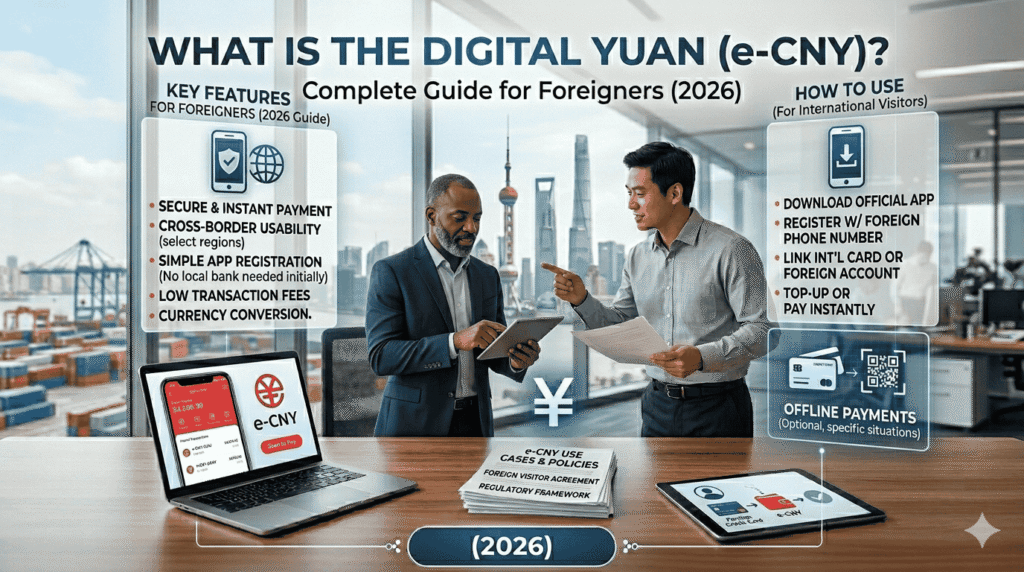
Since the 2022 Olympics, China has expanded the Digital Yuan’s foreign visitor access through a dedicated tourist wallet (旅游版数字人民币钱包). This wallet can be obtained by foreign nationals at selected bank counters in major Chinese cities — Beijing, Shanghai, Guangzhou, Shenzhen, Chengdu, and the pilot cities — by presenting a foreign passport. The tourist wallet is pre-loaded with e-CNY using a foreign Visa or Mastercard and can be used at Digital Yuan-enabled merchants throughout the pilot areas.
In 2026, Digital Yuan merchant acceptance is expanding but remains substantially narrower than Alipay and WeChat Pay acceptance. Major state-owned retail chains (Sinopec petrol stations, major supermarket chains), government service venues, selected transport operators, and an increasing number of restaurants and shops in pilot cities accept Digital Yuan. The government has actively promoted Digital Yuan use through consumption subsidies — issuing Digital Yuan coupons to residents and visitors for spending in pilot areas.
The practical recommendation for foreign visitors in 2026 is to treat the Digital Yuan as a supplementary payment option worth exploring, not as a primary tool to replace Alipay or WeChat Pay. Its acceptance is narrower and the setup process (requiring a bank visit to obtain the tourist wallet in some configurations) adds friction that the Alipay/WeChat Pay setup process, done in advance, avoids. However, for visitors interested in China’s financial technology landscape, obtaining and using a Digital Yuan tourist wallet provides direct experience with the most significant CBDC deployment in history — and that experiential knowledge has genuine value for anyone interested in the future of digital money.
5. Implications for China’s Financial System
The Digital Yuan’s trajectory has implications that extend well beyond Chinese domestic payments. In the context of cross-border trade, China is exploring the use of e-CNY for international settlement through the mBridge project (Multi-CBDC Bridge) jointly developed with the central banks of Hong Kong, the UAE, and Thailand. If this infrastructure matures, it could allow importers in multiple countries to pay Chinese suppliers directly in Digital Yuan through an interoperable CBDC network — bypassing the SWIFT system and the correspondent banking chains that currently create cost and delay in cross-border transactions.
For businesses and analysts tracking China’s financial system, the Digital Yuan is a technology trajectory rather than a current operational reality for cross-border commerce. Its domestic rollout is proceeding deliberately and will continue to expand over the coming years. The foreigners who understand what it is, how it works, and where it is heading are better equipped to navigate China’s evolving financial landscape — whether as traders, investors, or informed observers of one of the most consequential monetary experiments of the twenty-first century.
Frequently Asked Questions
Is the Digital Yuan a cryptocurrency?
No. The Digital Yuan is a centralised central bank digital currency, not a cryptocurrency. It has no blockchain decentralisation, no mining, no anonymous transactions, and no speculative market value — it is always worth exactly one RMB because it is issued directly by the PBoC as legal tender.
Can I use Digital Yuan to pay Chinese suppliers internationally?
Not in general commercial practice as of 2026. The mBridge cross-border CBDC pilot is in testing with limited participating banks and countries. Mainstream cross-border Digital Yuan settlement for importers remains several years away from commercial availability.
Does the Digital Yuan earn interest?
No. By design, the PBoC has specified that e-CNY does not bear interest. This prevents it from competing with bank deposits as a savings instrument, preserving the commercial banking system’s deposit base.
Conclusion
The Digital Yuan is China’s most significant monetary infrastructure project in a generation, and understanding it is increasingly relevant for anyone who engages with China’s financial system. For foreign visitors in 2026, it offers a working tourist wallet experience and a window into a technology that is reshaping China’s domestic payments landscape. For importers and businesses, it represents a cross-border payment future worth monitoring as the mBridge infrastructure develops. For observers of global financial systems, it is the most advanced CBDC deployment in the world — a proof of concept that central bank digital currencies are operationally viable at scale, with implications for every major economy that is watching China’s experiment and contemplating its own. The dumpling transaction at the Beijing Olympics was the opening chapter. The story it was beginning is still very much being written.