In the mid-2000s, a legend circulated among electronics engineers: that Huaqiangbei in Shenzhen was the only place on earth where you could walk in with a rough circuit diagram and walk out an hour later with every component, a prototype PCB, and a quote for 10,000 units. The legend was, and remains, essentially accurate. Shenzhen’s electronics market district — centred on Huaqiang Road North — is an ecosystem without parallel: part market, part factory district, part innovation lab, part parts graveyard, and wholly unlike any commercial district in any other city on earth. This guide navigates it for importers, engineers, and curious buyers.
1. What Is Huaqiangbei? The Ecosystem Explained
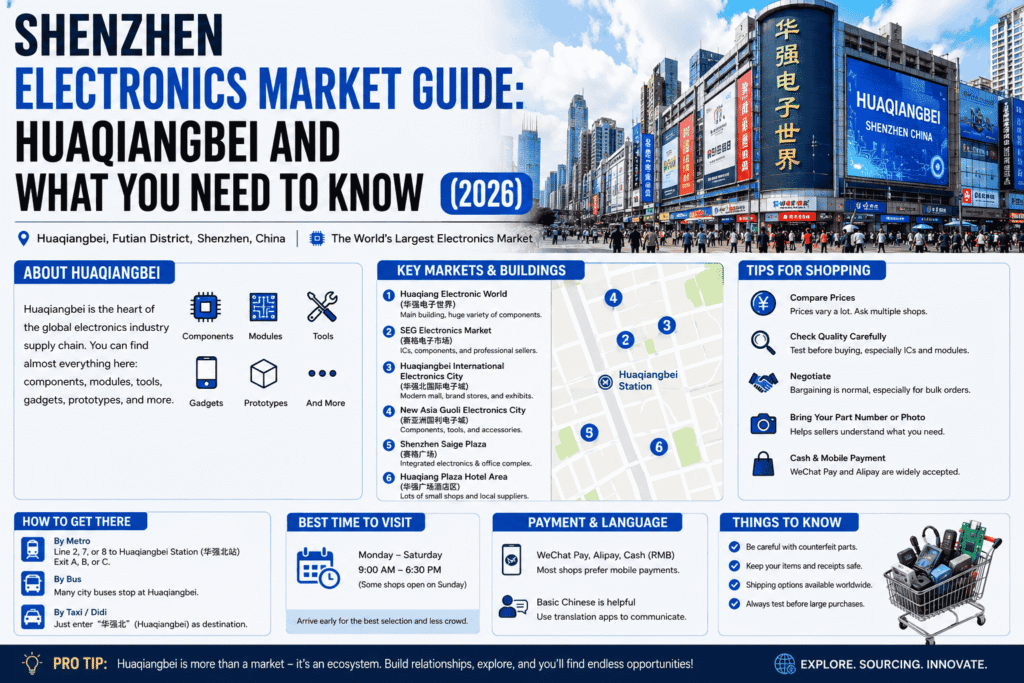
Huaqiangbei (华强北, meaning “North of Huaqiang Road”) refers to a dense commercial district in Futian District, Shenzhen, spanning approximately 1 square kilometre of streets, malls, and wholesale buildings dedicated almost entirely to electronics, components, gadgets, and technology products.
The district contains dozens of multi-storey malls, each specialising in different segments:
- SEG Electronics Market (赛格电子市场): The original and most famous — components, modules, semiconductors, capacitors, ICs. Engineer heaven. Open to all buyers
- Huaqiang Electronics World (华强电子世界): Consumer electronics, mobile phones, tablets, accessories, watches
- Mingtong Digital City (明通数码城): Mobile phones (new and refurbished), phone accessories, batteries, screens
- Yuanwang Digital Mall (远望数码城): Security cameras, surveillance equipment, networking hardware
- Wanjia Digital City (万家数码城): LED lighting, display panels, LED strips
Adjacent streets host hundreds of component dealers, PCB fabricators, prototype workshops, and packaging suppliers that collectively form one of the world’s most concentrated technology supply chains.
2. Getting to Huaqiangbei
By metro: Huaqiangbei Station (Line 1, Luobao Line) exits directly into the market district. From Shenzhen North Station (high-speed rail from Guangzhou: 30 min; from Hong Kong Hung Hom: 14 min on the Express Rail Link): take Metro Line 4 south to Gangxia, transfer to Line 1 westbound to Huaqiangbei — approximately 25 minutes total.
From Hong Kong: The most common entry for international buyers is via the Hong Kong-Shenzhen border crossings (Luohu/Lo Wu or Futian/Lok Ma Chau). Both crossings connect to Shenzhen’s metro network. Huaqiangbei is approximately 30–40 minutes from either crossing by metro.
International access: Shenzhen Bao’an International Airport (SZX) serves direct flights from most Asian and many long-haul destinations. The airport is connected to Huaqiangbei by metro (Line 11 to Window of the World, then Line 1 east — approximately 45 minutes).
3. What You Can Buy at Huaqiangbei
Electronic components: Resistors, capacitors, inductors, transistors, ICs, microcontrollers (Arduino, STM32, ESP32 at 30–60% below Western retail), sensors, connectors. SEG Electronics Market is the primary source. Prices are wholesale for bulk; retail for small quantities is still competitive.
Consumer electronics: Smartphones, tablets, earphones, smart watches, action cameras, drones (DJI and alternatives), power banks, laptops, gaming devices. Both brand-name products and OEM-branded alternatives. Genuine Apple products are available at roughly Apple Store pricing — counterfeits are also present (more on this below).
LED and lighting products: Wanjia Digital City and surrounding streets house the world’s most concentrated LED product market. LED strips, smart bulbs, display panels, signage modules, grow lights, and custom LED arrays — at prices typically 40–70% below Western wholesale.
PCB fabrication and prototyping: The streets around Huaqiangbei host dozens of PCB fabrication shops that can produce prototype boards within 24–48 hours from your Gerber files. JLCPCB and PCBWay (both with global shipping services) are Shenzhen-based and reflect the district’s prototype manufacturing capabilities.
Phone repair components: For phone repair businesses, Mingtong and surrounding malls offer every conceivable replacement part for major smartphone brands — screens, batteries, charging ports, cameras — at wholesale prices.
4. Payment at Huaqiangbei
Payment options have evolved significantly with Shenzhen’s role as China’s most tech-forward city:
WeChat Pay and Alipay: Universal and preferred by sellers. QR codes at every booth. For foreign buyers with foreign-card-linked accounts, this works well for small-to-medium purchases within your annual limit. Shenzhen vendors are more experienced with foreign buyers than most Chinese cities and rarely refuse digital payment.
Cash RMB: Accepted everywhere. Bank of China and ICBC branches within the Huaqiangbei district (multiple locations) handle currency exchange. For large purchases, negotiate a price in RMB cash — cash discounts of 3–8% are common for substantial orders where vendors save the payment processing friction.
USD cash: Some larger wholesale dealers in the international trade buildings (particularly in the upper floors of major malls) accept USD cash for bulk orders. They apply their own exchange rate — verify before assuming the rate is competitive.
Bank transfer for bulk orders: Wholesale orders above ¥10,000 are routinely handled by T/T bank transfer, arranged after visiting the booth and confirming specifications and pricing. The vendor provides company bank details; you transfer from your international account. Confirm the transfer reference number with the vendor before goods are released.
5. Counterfeit Products: How to Identify and Avoid Them
Huaqiangbei has a well-documented history of counterfeit product distribution, and the reputation is partially earned. However, the situation is more nuanced than “everything is fake”:
Products likely to be counterfeit: Brand-name smartphones (especially Apple), branded accessories, name-brand headphones (particularly AirPods and popular audio brands), certain microcontrollers and integrated circuits where a “grey market” of remarked or downgraded chips exists.
Products that are generally what they appear: Generic/OEM electronics without brand claims, LED components, electronic modules, PCBs, unbranded accessories. These are not counterfeit — they are genuine products without brand affiliation.
Red flags for counterfeits: Prices significantly below Apple Store / Samsung / Sony official retail for claimed genuine branded goods; packaging that is close to but not identical to retail box; sellers who are evasive about product origin or warranty.
Practical approach: If you want genuine branded electronics, buy from official brand stores in Shenzhen’s high-street malls (MixC, KK Mall, Futian COCO Park) or from authorised online retailers. Huaqiangbei’s strength is OEM and unbranded electronics, components, and accessories — not genuine Apple or Samsung products at impossibly low prices.
6. Logistics: Getting Your Purchases Home
For personal quantities (samples, small orders, prototype components): DHL, FedEx, and SF Express (China’s premium domestic courier with international service) all have drop-off points in or near Huaqiangbei. This is the simplest option for small, high-value shipments.
For commercial quantities: freight forwarders based in the Futian District or Longhua (where Foxconn’s Shenzhen campus is located) handle full container and LCL consolidation services. Electronics shipping requires careful attention to hazardous goods rules — batteries have strict restrictions on both air and sea freight. Confirm lithium battery shipping compliance with your forwarder before booking.
For Hong Kong buyers: day trips to Huaqiangbei with purchases carried back across the Lo Wu or Futian border are common. Be aware of Hong Kong customs regulations on commercial quantities — personal amounts are generally fine; commercial import requires relevant documentation.
Frequently Asked Questions
Q: Do I need to speak Chinese to shop at Huaqiangbei?
A: Basic communication in English is possible at most major malls — Shenzhen’s tech industry context means English exposure is higher than average. Google Translate voice mode covers gaps effectively. For complex technical component sourcing, bringing or hiring a Chinese-speaking assistant is worthwhile.
Q: What is the best time to visit Huaqiangbei?
A: Weekdays during normal business hours (9 AM–7 PM) see the most active wholesale trading. Weekend afternoons see more retail and tourist traffic. Avoid major Chinese public holidays when many dealers close for 3–7 days.
Q: Can I order online from Huaqiangbei suppliers?
A: Many Huaqiangbei dealers also operate on Taobao, 1688.com, or Alibaba. Searching on these platforms for the products you find in person can yield good online follow-up ordering relationships without repeated trips.
Conclusion: The Workshop of the Digital World
Shenzhen’s Huaqiangbei district is, in the most literal sense, where much of the world’s digital hardware originates. The components in your wireless earphones, the LEDs in your office lighting, the modules in the IoT device on your wrist — many of them passed through these streets at some point in their supply chain. For the importer, the engineer, or the entrepreneur who wants direct access to that supply chain at its source, no destination in the world offers the density, the range, and the price point of Huaqiangbei. Come with cash, come with a product list, and come prepared to be dazzled by what a single kilometre of commercial real estate can contain.