Every physical product imported from China begins the same way: a factory in Dongguan, Shenzhen, or Yiwu loads your goods into a cardboard box, wraps them in plastic, and places them on a pallet. From that moment, a complex chain of logistics, documentation, customs agencies, and carrier networks moves those goods — sometimes thousands of kilometres — to a warehouse or doorstep in Lahore, Lagos, London, or Los Angeles. This journey, which most importers encounter with more anxiety than understanding, is the subject of this guide: a complete, practical manual for shipping from China in 2026.
1. The Three Main Shipping Methods
Every China import shipment travels by one of three primary modes, or a combination:
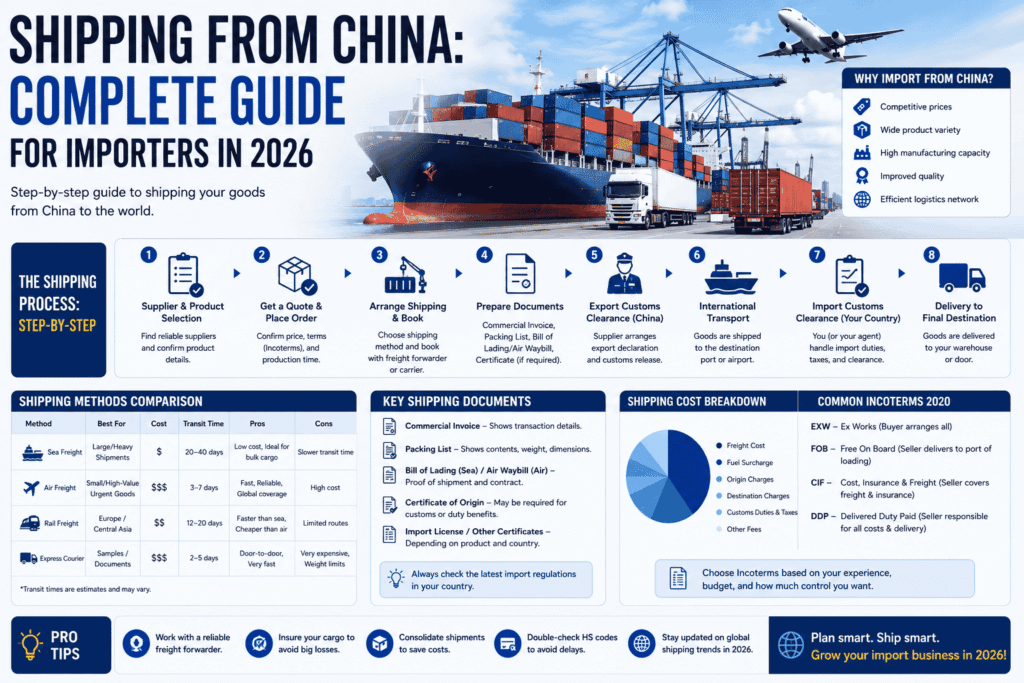
Sea Freight: Container shipping from Chinese ports (primarily Shanghai, Ningbo, Shenzhen/Yantian, Guangzhou/Nansha) to destination ports worldwide. The dominant mode for commercial import volumes. Cost: typically USD 1–3 per kg for LCL (Less than Container Load); USD 800–3,000 per FCL (Full Container Load) depending on destination and market conditions. Transit time: 18–45 days depending on destination.
Air Freight: Cargo on commercial airlines or dedicated freighter services from major Chinese airports (Shanghai Pudong, Beijing Capital, Guangzhou Baiyun, Shenzhen Bao’an). Cost: USD 4–10 per kg depending on destination and service level. Transit time: 5–10 days door-to-door. Used for time-sensitive goods, high-value items, and small early inventory shipments.
Express Courier: DHL, FedEx, UPS, and SF International for parcel-level shipments. Door-to-door service from the factory to the final destination. Cost: USD 15–50 per kg (higher for small packages). Transit time: 3–7 days. Best for samples, small orders, and urgent replenishments where volume does not justify air freight minimum charges.
2. LCL vs FCL Sea Freight: Which Should You Use?
| Factor | LCL (Less than Container) | FCL (Full Container) |
|---|---|---|
| Volume threshold | Below ~15 cubic metres | Above 15 CBM (20ft) or 28 CBM (40ft) |
| Cost structure | Per CBM (cubic metre) or per 1,000kg | Flat rate per container |
| Transit time | Slower — consolidation adds 3–7 days | Faster — direct loading and sailing |
| Damage risk | Higher — goods handled multiple times | Lower — sealed container, direct |
| Goods mixing | Your goods share with other importers | Entire container is yours |
| Customs flexibility | Less flexible — shared documentation | Full control of documentation |
Most first-time and small-to-medium importers start with LCL and transition to FCL as order volumes grow to justify full container loads.
3. China to Key Destination: Transit Times and Costs
| Destination | Sea Freight Transit | Air Freight Transit | LCL Rate (approx) |
|---|---|---|---|
| Pakistan (Karachi) | 18–25 days | 4–6 days | USD 80–120/CBM |
| UK (Felixstowe/Southampton) | 28–35 days | 6–9 days | USD 120–180/CBM |
| USA (Los Angeles/Long Beach) | 14–18 days | 5–8 days | USD 100–160/CBM |
| Nigeria (Lagos/Apapa) | 30–40 days | 7–10 days | USD 130–200/CBM |
| Bangladesh (Chittagong) | 20–28 days | 5–7 days | USD 85–130/CBM |
| Australia (Melbourne/Sydney) | 18–25 days | 5–8 days | USD 110–160/CBM |
Rates are indicative and fluctuate significantly based on global shipping market conditions, fuel costs, and demand cycles.
4. Incoterms: Understanding Who Pays What
Incoterms (International Commercial Terms) define the split of cost and risk between buyer and seller. The most common terms in China trade:
FOB (Free on Board): The supplier delivers goods to the named Chinese port (e.g., FOB Shanghai). From there, you (the buyer) arrange and pay for sea freight, insurance, and destination customs clearance. The most common and buyer-friendly term for experienced importers — you control the freight and can shop competitively.
CIF (Cost, Insurance, Freight): Supplier arranges and pays for shipping, insurance, and delivers to your destination port. You pay destination customs clearance and inland haulage. Convenient for first-time importers; typically more expensive as the supplier’s freight rate includes a margin.
DDP (Delivered Duty Paid): Supplier delivers goods to your door, fully cleared through customs. The easiest term for the buyer — you simply receive the goods. Most expensive, as the supplier prices in all logistics costs and risks plus profit margin. Common for small parcels and AliExpress-style consumer deliveries.
EXW (Ex Works): Supplier makes goods available at their factory gate. You arrange all transport from the factory. Maximum buyer control; maximum buyer responsibility. Requires either a China-based freight forwarder or agent to collect from the factory.
5. Choosing and Working with a Freight Forwarder
A freight forwarder is your logistics partner for China-to-destination shipments. They book space on vessels or aircraft, handle customs documentation, manage port procedures, and arrange delivery. Finding a good freight forwarder is as important as finding a good supplier.
China-based forwarders: Offer lower rates (they have direct relationships with carriers) and seamless collection from Chinese factories. Many Yiwu and Guangzhou forwarders specialise in specific destination countries (Pakistan routes, Africa routes, Europe routes). Recommended for experienced importers.
Destination-country forwarders: Companies in your home country that arrange China shipping. Higher rates (they add a margin on top of the China-side rate) but more accountability — they operate under your jurisdiction’s law, speak your language, and handle all documentation in familiar formats. Better for first-time importers.
Key questions to ask a forwarder: Do you have experience with my specific destination country? What are your all-in rates including destination charges? What documentation do you require from the supplier? How do you handle customs classification disputes?
6. Customs Clearance: What You Need to Know
Every import shipment must clear customs in the destination country. Key requirements:
HS Code classification: Every product has a Harmonized System (HS) code that determines the applicable import duty rate. Incorrect classification can result in duty underpayment (causing clearance delays or penalties) or overpayment. Ask your supplier or forwarder to confirm the correct HS code for your product before shipment.
Commercial Invoice: The supplier’s invoice showing product description, quantity, unit price, total value, and Incoterms. This is the primary document customs authorities use to assess duty. Ensure it is accurate — undervaluing goods on customs invoices is fraud in most jurisdictions.
Packing List: Detailed breakdown of contents, box counts, weights, and dimensions. Customs authorities cross-reference against the commercial invoice.
Bill of Lading (B/L) or Airway Bill: The carrier’s document acknowledging receipt of goods and confirming their destination. Required for customs clearance in most countries.
Certificate of Origin (CO): Document confirming goods are manufactured in China. Required for preferential duty rates under trade agreements (e.g., China-Pakistan FTA, which reduces duty rates for Pakistani importers).
7. Paying for Shipping: Methods and Currency
Freight costs from China-side forwarders are typically quoted and paid in USD. Payment methods:
- Bank transfer (T/T): Standard for established forwarder relationships. Pay the quoted freight cost in USD to the forwarder’s account before goods are released
- Alipay/WeChat Pay: Accepted by some smaller Yiwu and Guangzhou forwarders for CNY-denominated freight invoices. Convenient for in-person logistics arrangements during factory visits
- Credit terms: Regular importers with established forwarder relationships may negotiate 30-day payment terms for freight — common at volume
Frequently Asked Questions
Q: What is the cheapest way to ship small quantities from China?
A: For packages under 2 kg, ePacket (China Post-based) or AliExpress Standard Shipping is cheapest — often free on AliExpress consumer orders. For 2–20 kg, DHL or SF Express is price-competitive. Above 20 kg, sea freight LCL becomes more cost-effective than courier per kg.
Q: How do I avoid import duty?
A: You cannot legally avoid import duty — goods from China are subject to your country’s tariff schedule. Undervaluing goods on customs invoices is illegal and risks seizure plus penalties. The legal approach is correct HS code classification, use of applicable free trade agreement rates, and accurate invoicing.
Q: What happens if my shipment is held by customs?
A: Provide your customs broker with all requested documentation immediately. Common reasons for holds: incorrect/missing documentation, HS code query, undervalued invoice suspicion, or prohibited/restricted item. Most holds are resolved within 3–10 business days with complete documentation.
Conclusion: Logistics Is the Final Mile of Sourcing
The factory in Dongguan does not care how your goods reach Lagos. The vessel operator does not care what is in the container. Customs authorities care only about documentation accuracy. The entire logistical chain is indifferent to your business outcomes — it simply moves, processes, and clears. Your competitive advantage is knowing the system well enough to move goods through it faster, cheaper, and with fewer surprises than your competitors. That knowledge — Incoterms, freight modes, forwarder selection, customs documentation — is not mysterious. It is learnable, like every other aspect of importing from China. Learn it once, and every subsequent shipment is a managed process rather than an anxious gamble.