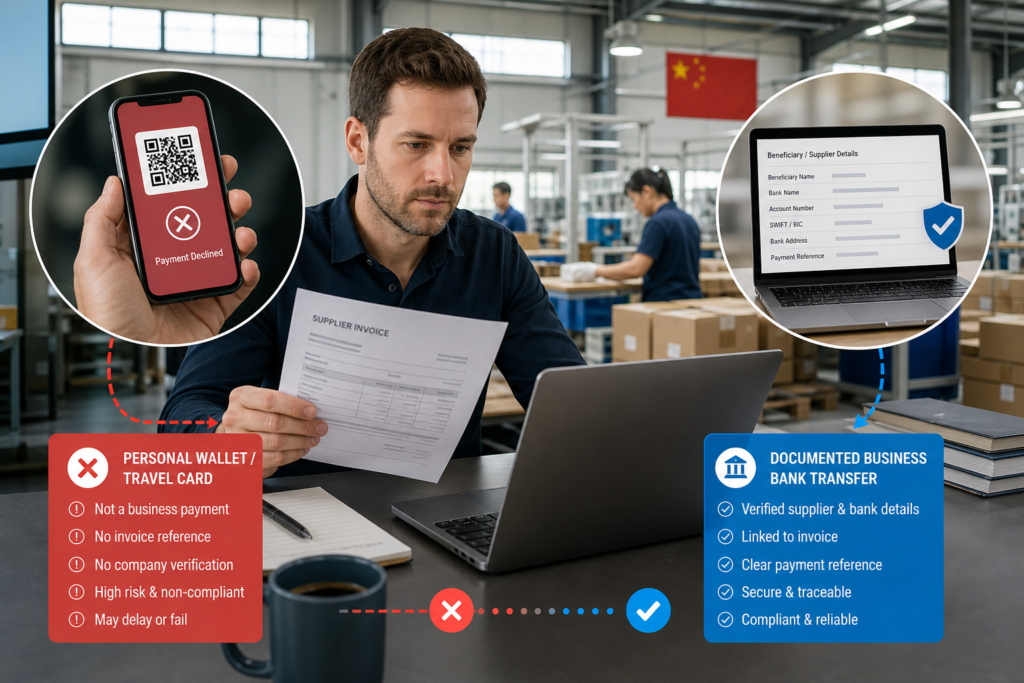
An international card linked to Alipay can work for eligible everyday purchases in China but still fail when you try to pay a supplier, factory, sourcing agent, or individual collection code. Linking the card does not turn a personal travel wallet into a general business-remittance account. The transaction can be rejected because of the merchant category, QR-code type, card-issuer authorization, wallet limits, account verification, or the commercial nature of the payment.
If the payment represents a business invoice, do not keep changing the amount or repeatedly scanning a different personal code. Confirm the supplier and use a documented payment route that supports the invoice, beneficiary, currency, and purpose.
Why a travel purchase can work when a supplier payment fails
Official guidance presents foreign-card mobile payment as a convenience for visitors making payments in daily consumption scenarios. Examples include restaurants, hotels, attractions, shops, transport, and other participating merchants. The Chinese government’s 2025 guide says card brands, limits, charging standards, and scope can vary by payment product and directs users to the live product agreement.
A supplier invoice is different. It may be a higher-value commercial settlement, require a payment reference and supporting documents, and need to arrive in a company bank account whose legal beneficiary matches the contract. A foreign consumer card being successfully linked proves only that the issuer and wallet accepted the card connection; it does not guarantee every recipient or transaction type is eligible.
Five checks before trying again
1. Is the recipient a registered merchant?
Ask whether the QR code belongs to the supplier’s registered business or to an employee’s personal wallet. International-card support is designed around eligible merchant consumption. A personal collection code, person-to-person transfer, red packet, balance top-up, or cash-like transaction may not accept the foreign card.
Do not ask the supplier to cycle through employees’ codes. That weakens the connection between the invoice, recipient, and payment record and increases recovery risk if a dispute occurs.
2. Does the beneficiary match the contracting company?
Compare the company name on the contract, pro forma invoice, business licence, and bank-beneficiary instructions. If the beneficiary is a different company or an individual, obtain a written explanation and independently verify it through a known supplier contact. A changed beneficiary sent only through chat or email can indicate business-email compromise or invoice fraud.
3. Is the amount within the live wallet and card limits?
China’s visitor guidance has described a USD 5,000 equivalent single-transaction ceiling and USD 50,000 annual ceiling for bound international cards, but a lower wallet, merchant, issuer, or risk-control limit can apply. Limits are not a promise that a payment up to that amount will be approved. Check the amount and message shown inside Alipay, then ask the issuer whether it declined the authorization.
4. Is the card authorized for the transaction?
The issuing bank must approve both card linking and payment. Confirm that the card is active, has sufficient available credit, supports international and online purchases, and is not blocking the merchant category. Use only official bank contact details. Never share an SMS code or wallet PIN with the supplier.
5. Does the payment need commercial documentation?
For goods, confirm the invoice number, description, quantity, Incoterm, shipment terms, beneficiary, currency, and who bears bank charges. A business-capable bank or payment provider may ask for the invoice, purchase agreement, supplier verification, or purpose of payment. That documentation is useful: it creates an auditable link between your money and the order.
What common Alipay messages can and cannot tell you
| What you see | Likely area to check | Next action |
|---|---|---|
| Card not supported or payment method unavailable | Transaction type, merchant eligibility, card network | Check another eligible card or use a documented supplier-payment route |
| Bank declined | Issuer authorization | Contact the issuer through its official app or number |
| Risk-control or security message | Account verification, unusual amount, recipient, repeated attempts | Stop retries; follow in-app verification or contact official Alipay support |
| Limit exceeded | Wallet, issuer, merchant, or regulatory/product limit | Identify which limit applies; do not evade it by artificial splitting |
| Personal transfer unavailable | Foreign-card funding restrictions | Request company bank details tied to the invoice |
An error message rarely proves the supplier is fraudulent, and it does not prove Alipay is broken. It identifies a point for investigation. For ordinary consumer problems such as a crashing app, failed verification, or a QR code that will not scan, use Extentage’s existing Alipay troubleshooting guide.
Should you split a supplier invoice into smaller wallet payments?
Not simply to bypass a limit, fee, or risk-control decision. Splitting can disconnect payments from the invoice, complicate refunds and accounting, trigger additional reviews, and leave funds scattered across personal recipients. If staged payments are commercially appropriate, define them in the contract—for example, deposit, pre-shipment balance, and retained amount—and send each stage to the verified contractual beneficiary with a clear invoice reference.
A safer workflow for paying a Chinese supplier
- Verify the company. Obtain its Chinese legal name, unified social credit code, business licence, registered address, and authorized contact.
- Confirm the invoice. Match goods, value, currency, delivery terms, and beneficiary.
- Verify bank details out of band. Call a known contact using a number obtained independently, especially after any change.
- Compare supported routes. Consider a business bank transfer or regulated cross-border provider that supports commercial payments to China and the required currency.
- Agree on fees and FX. State whether the sender, intermediary, or beneficiary pays charges and how an underpayment will be handled.
- Use the invoice reference. Preserve the confirmation, rate, fee disclosure, and beneficiary record.
- Confirm receipt with finance staff. Do not rely only on a salesperson or chat screenshot.
Start with the full guide to sending RMB to Chinese suppliers. For currency planning, review the RMB versus USD exchange-rate guide. If the supplier asks for USDT instead of a documented bank payment, read the site’s USDT-to-RMB supplier-payment risk guide before proceeding.
When Alipay may still be appropriate
Alipay can be appropriate for an eligible, clearly identified merchant purchase—for example, paying a participating shop for samples collected in person—when the app accepts the foreign card and the receipt adequately documents the transaction. It is less suitable as the default route for a substantial factory invoice, deposit to a personal code, or payment that your company must reconcile for tax, customs, or audit purposes.
The government’s payment guide for overseas visitors describes mobile wallets alongside bank cards and cash for visitor convenience. It does not state that a passport-verified personal wallet supports every form of commercial remittance.
Frequently asked questions
Why can I pay a restaurant but not my factory?
The restaurant payment is an eligible consumer merchant purchase. The factory request may use a personal code, unsupported merchant category, higher-risk amount, or commercial transaction outside the foreign-card flow. Ask for verified company payment instructions linked to the invoice.
Can I pay a supplier’s employee and have the company acknowledge it?
That creates avoidable legal, accounting, and recovery risk. Use the contractual company beneficiary unless your professional adviser approves another documented arrangement and the supplier formally authorizes it.
Does linking a Visa or Mastercard guarantee payment approval?
No. The issuer must authorize the payment, and the wallet, merchant, transaction type, verification status, and applicable limits must also permit it.
Should I keep retrying after a risk-control message?
No. Repeated attempts can complicate review or create duplicate authorizations. Save the message, check verification and issuer status, and use official Alipay support.
Sources and review note
- Guide to Working and Living in China (2025) — international-card linking, issuer authorization, varying product scope and limits.
- Payment service guide for overseas visitors — visitor payment methods and use cases.
- State Administration of Foreign Exchange — primary official portal for current foreign-exchange material.
Written by the Extentage editorial team. Reviewed on August 2, 2026. This is practical payment education, not legal, tax, or individualized financial advice. Product eligibility and rules can change; verify live terms and obtain professional advice for material transactions.