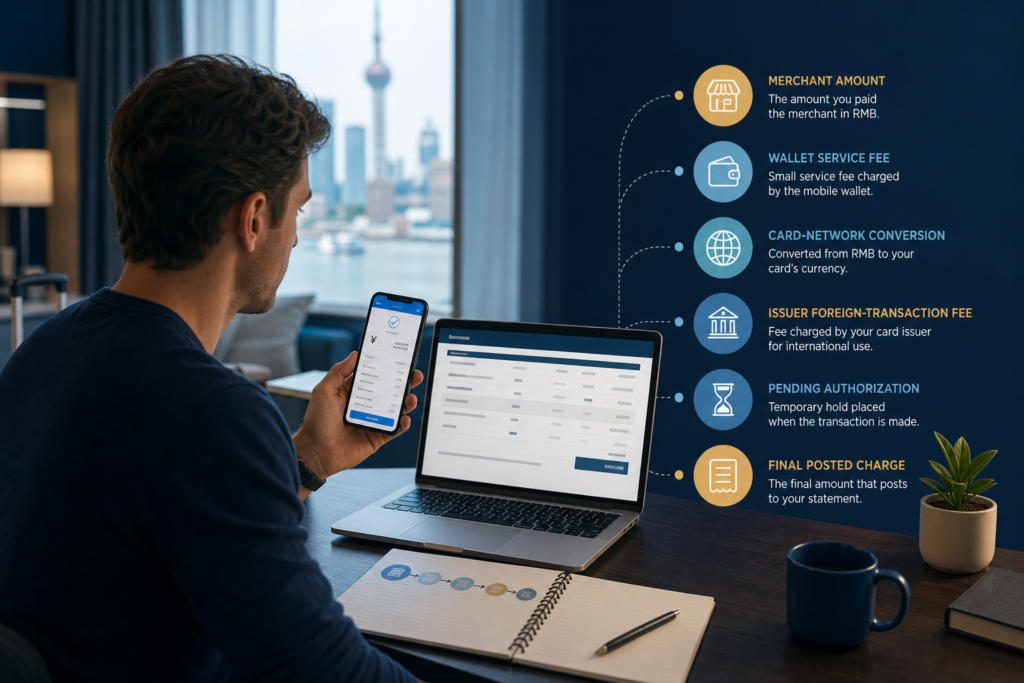
If an Alipay or WeChat Pay purchase looks different on your card statement, do not assume the wallet added a hidden charge. Compare the RMB merchant amount, wallet service fee, billing currency, exchange rate, issuer fee, and whether the entry is still pending. These are separate parts of one payment, controlled by different parties.
This guide helps foreign visitors identify the difference, preserve evidence, and contact the right company. It complements our Alipay versus WeChat Pay fee comparison, which explains the standard RMB 200 threshold.
The six figures to compare
| Figure | Where to find it | Who controls it |
|---|---|---|
| Merchant amount in RMB | Merchant receipt and wallet record | Merchant |
| Wallet service fee | Wallet confirmation and receipt | Alipay or WeChat Pay |
| Authorization amount | Pending card activity | Payment chain and issuer display |
| Conversion rate | Issuer statement or network calculator | Network and/or issuer |
| Foreign-transaction fee | Card statement and agreement | Card issuer |
| Final posted amount | Completed statement entry | Issuer after settlement |
Step 1: confirm the original RMB charge
Open the transaction inside Alipay or WeChat Pay and record the merchant name, time, RMB amount, service fee, funding card, and transaction ID. Compare it with the merchant receipt. If the merchant amount is wrong, contact the merchant first because it created the purchase amount.
For international-card QR payments, Chinese government visitor guidance states that a qualifying transaction of RMB 200 or less has no added platform service fee, while a transaction above RMB 200 carries a 3% service fee on the transaction amount. The fee should be identifiable rather than treated as an unexplained exchange-rate difference. See the official Ministry of Commerce guide.
Step 2: wait for a pending authorization to post
A pending entry is not always the final statement amount. Hotels, transport services, deposits, refunds, and adjusted purchases can produce temporary authorizations or later changes. Do not add a pending entry and its replacement posted entry together unless your issuer confirms both are completed charges.
Save a screenshot, but allow the issuer’s normal settlement period before treating a pending-to-posted difference as an error. If a transaction disappears, reverses, or posts twice, ask which entries are authorizations and which are settled charges.
Step 3: separate conversion from an issuer fee
A payment recorded in RMB must be converted if your card bills in another currency. Conversion and a foreign-transaction fee are not the same thing. Some issuers show the fee separately; others present it according to their card agreement.
Check the card’s current pricing document instead of assuming every bank charges the same percentage. The US Consumer Financial Protection Bureau explains that a foreign-transaction fee is an issuer-imposed transaction charge for foreign-currency or foreign-merchant purchases. Its credit-card contract definitions also note that a processing-date rate can differ from rates seen on other dates.
Worked example
Suppose the merchant amount is RMB 500 and the standard wallet fee applies. The wallet record should show RMB 15 as 3% of RMB 500, making the wallet-side total RMB 515. Your issuer then converts that total under the applicable network and card terms. If the issuer separately charges 2%, that is an issuer fee—not another Alipay or WeChat Pay fee.
Do not compare the statement with a rate found through a general web search and automatically call the difference a markup. Use the processing information and rate source applicable to your card.
Step 4: check whether currency conversion was offered
Dynamic currency conversion, or DCC, occurs when a merchant, ATM, or its provider offers to charge in your home billing currency instead of local currency. Visa states that the screen or receipt should disclose both currencies, the exchange rate, and additional fees or markup, and the customer must be able to accept or decline. See Visa’s DCC explanation.
Mastercard similarly describes DCC as a choice between local and billing currency; local-currency conversion follows the issuer route, while DCC uses the acquirer’s offered rate. See Mastercard’s 2025 DCC guide.
Most ordinary in-app QR payments present the merchant charge in RMB. Do not claim DCC occurred unless a screen, receipt, or statement shows a home-currency choice or merchant-side conversion. If a terminal selected your billing currency without consent, keep the receipt and contact the issuer.
Step 5: identify refunds, reversals, and duplicate-looking entries
- Reversal: the original authorization is released rather than returned as a new credit.
- Refund: a separate credit may arrive after the purchase posts.
- Duplicate authorization: two pending entries may not become two settled charges.
- Duplicate settled charge: two completed entries for one purchase require prompt investigation.
Match transaction IDs, timestamps, and RMB amounts. Currency movement between purchase and refund dates can make the home-currency debit and credit differ even when the RMB refund is correct.
Who should you contact?
- Merchant: wrong purchase amount, cancellation, missing refund, or duplicated sale.
- Alipay or WeChat Pay support: wrong wallet service fee, unclear wallet status, or disagreement between merchant and wallet records.
- Card issuer: issuer fee, conversion method, pending authorization, statement descriptor, or card dispute.
Use official support channels. Never send a full card number, password, SMS code, or wallet payment PIN to a merchant or anyone claiming to investigate the fee.
Evidence checklist before opening a case
- Merchant receipt and order number
- Wallet transaction ID and RMB amount
- Wallet service fee shown before or after payment
- Last four digits of the funding card
- Pending and final statement screenshots
- Issuer’s current foreign-transaction-fee terms
- Any currency-choice screen or DCC receipt
If the payment failed rather than posted incorrectly, follow the site’s Alipay troubleshooting guide. Travelers planning a longer stay can review how foreign residents may apply for a Chinese bank account; eligibility and approval are not guaranteed.
Consumer purchases are not supplier remittances
This process is for a personal merchant purchase funded by an international card. Paying a factory or supplier invoice requires verified beneficiary details, commercial documentation, agreed currency and fees, and a compliant business-payment route. Read how to send RMB to a Chinese supplier before treating a wallet transaction as business settlement.
Frequently asked questions
Why is the posted amount higher than the wallet receipt?
Common explainable reasons are the issuer’s conversion result, an issuer foreign-transaction fee, or comparison with a pending authorization. Compare the RMB amount and wallet fee first, then ask the issuer to explain its conversion and fees.
Can the exchange rate change before the payment posts?
It depends on the network and issuer process. Do not assume the rate visible on purchase day is necessarily the rate used for your statement; consult the issuer’s terms and transaction details.
Are there always four or more hidden fees?
No. The original manuscript’s claim that every payment stacks four fees was inaccurate. A transaction may have a wallet fee, issuer fee, conversion, or DCC, but these do not all apply automatically and should not be counted twice.
Written by the Extentage editorial team. Reviewed on August 2, 2026. App rules, promotions, card agreements, and processing practices can change; verify live terms before paying.