
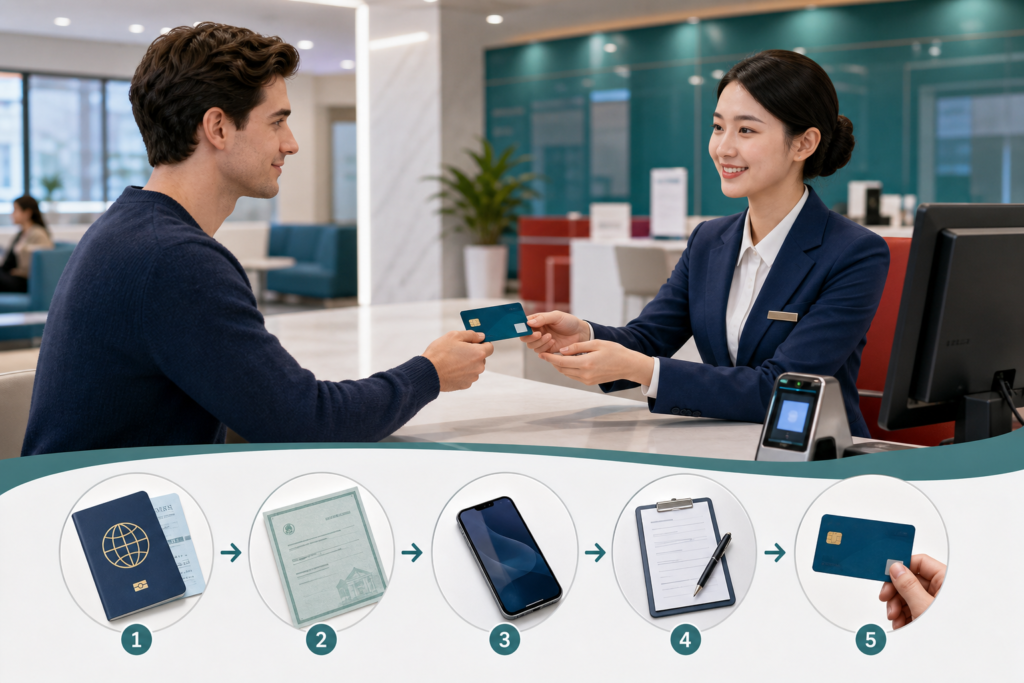
Foreign nationals can apply for a personal RMB bank account at a commercial bank branch in China, but approval is not automatic. A passport or Foreign Permanent Resident ID Card establishes identity; the bank may also require an eligible visa or residence permit, local residence registration, a Chinese phone number, employment or study evidence, tax information, and a clear reason for opening the account.
Long-term residents, employees, students, and other applicants with a documented connection to China generally have a clearer route than short-stay tourists. Requirements differ by bank, city, branch, visa category, and risk review, so confirm the current checklist with a suitable branch before visiting.
Can a foreigner open a bank account in China?
Yes, if the bank can verify the applicant’s identity, document validity, genuine account-opening intention, and intended use. Chinese government guidance says foreigners may take a passport or Foreign Permanent Resident ID Card to a commercial bank outlet to apply for a bank card. That is permission to apply—not a guarantee that every applicant, visa, or branch will qualify.
| Applicant situation | Likely evidence | Important qualification |
|---|---|---|
| Employee or business expatriate | Passport, valid stay/residence documents, work or employer evidence, residence registration | The bank verifies purpose and customer information. |
| Long-term student | Passport, student visa/residence permit, enrollment evidence, residence registration | Accepted visa categories and documents vary. |
| Foreign permanent resident | Foreign Permanent Resident ID Card and any bank-requested supporting information | The Five-Star Card is a lawful identity document for financial services. |
| Tourist or visa-free short stay | Passport and any requested supporting evidence | Do not assume eligibility; some published local guidance lists longer-term visa categories rather than tourist status. |
Documents to prepare
- Original valid passport or Foreign Permanent Resident ID Card
- Current visa, stay permit, or residence permit, where applicable
- Local residence registration from a hotel or public-security registration process
- Chinese mobile number registered consistently with your identity, if the bank requires it
- Employment, study, family, or other purpose evidence appropriate to your stay
- Tax identification information and foreign tax-residency declarations requested for compliance
- Chinese address and contact details
- Opening deposit, if required by the chosen account or card
Official Beijing guidance notes that a bank may request additional documents when it cannot accurately establish identity from the primary document. A tax certificate, utility bill, photo ID, or other supporting record may be requested. Call the branch and describe your nationality, visa category, purpose, and city before relying on a generic online checklist.
Which Chinese bank should a foreigner choose?
Major commercial banks—including Bank of China, ICBC, China Construction Bank, Agricultural Bank of China, and others—provide personal banking services, but this does not mean every branch handles foreign-document onboarding equally often. Choose based on branch capability and the service you actually need.
| Need | Question to ask before visiting |
|---|---|
| Daily RMB spending | Can this branch open a personal RMB debit account for my passport and visa category? |
| Salary | Does my employer require a particular bank or account name format? |
| International transfers | What inward-remittance currencies, purpose documents, limits, and fees apply? |
| English assistance | Does this branch regularly serve foreign customers or offer an appointment? |
| Mobile banking | Can my document type and phone number activate the app and online banking? |
Step-by-step branch process
- Select a capable branch. Prefer a larger branch in a commercial, university, or international district and confirm foreign-customer onboarding first.
- Bring original documents. Carry every relevant immigration, residence, employment, study, and tax document even if the phone checklist sounds shorter.
- Explain the genuine purpose. State whether the account is for salary, rent, tuition, or personal living expenses. Do not invent a reason.
- Complete identity and tax declarations. Enter your name exactly as the bank requires and keep it consistent with your passport, phone registration, employer, and payment apps.
- Answer compliance questions. The bank may ask about occupation, source of funds, expected transactions, tax residence, and international transfers.
- Review the account terms. Check card, maintenance, ATM, transfer, SMS, replacement, dormancy, and closure fees rather than relying on universal price claims.
- Activate essential services. Set the PIN privately, enable mobile banking and alerts if eligible, and make a small legitimate test transaction.
- Store the records securely. Keep the account name, branch, number, service contacts, and terms—but never store the PIN beside the card.
Can a Chinese account be linked to Alipay and WeChat Pay?
An eligible mainland bank card can generally provide domestic RMB funding for supported Alipay and Weixin Pay functions after the names and identity details match. This can avoid the international-card service fee that applies to certain payments, but it does not make every bank or wallet service free. Bank charges, transfers, withdrawals, account services, merchant restrictions, and risk controls can still apply.
For Alipay identity steps, see how to open and verify an Alipay account. For WeChat funding, review how linked cards and WeChat Pay top-ups differ. Never let an “account helper” control your phone, receive your SMS code, or register the account in another person’s name.
Common reasons an application is delayed or refused
- The visa or remaining authorized stay does not meet that bank’s account policy.
- Residence registration is missing, expired, or inconsistent with the address.
- The phone number, passport name, employer, or tax information does not match.
- The bank cannot understand or verify the stated account purpose.
- Required employment, study, or supporting documents are missing.
- The branch lacks the process or document-reading capability for that foreign document.
- Compliance screening requires additional review.
Ask the branch to identify the missing eligibility rule or document. A different branch may have more experience, but repeatedly submitting inconsistent information is not a solution. Short-stay visitors can often use international cards with Alipay or WeChat Pay instead of opening a mainland account.
Personal accounts are not supplier-payment shortcuts
A personal RMB account is intended for the purposes approved by the bank. Do not use it to collect customer money, operate an unregistered remittance service, exchange funds for other people, or conceal commercial payments. Overseas buyers paying a factory should use a documented regulated route tied to the contracting supplier and invoice; follow the safe RMB supplier-payment workflow.
Frequently asked questions
Can a tourist open a Chinese bank account?
Do not assume so. Banks conduct their own eligibility and risk review, and published local guidance may list longer-term visa categories. Ask a specific branch before visiting and use visitor payment options if you do not qualify.
How long does account opening take?
There is no reliable universal time. A straightforward application may be completed during one visit, while document, tax, identity, or compliance review can require more time or another appointment.
Can the account receive money from overseas?
Ask the bank before the transfer. Currency, purpose, supporting documents, foreign-exchange rules, account capability, sender information, limits, and fees all matter.
Sources and review note
- State Council: Working and Living in China guide
- Beijing government: overseas individual bank-account requirements
- Shanghai government: bank-account opening guide and visa categories
- Shanghai government: payment methods for foreigners, updated July 2026
- Weihai government: foreign employee bank-account process
- People’s Bank of China: optimizing payment services for overseas visitors
Prepared by the Extentage Editorial Team for foreign residents, students, employees, and business visitors in China. Fact-checked against the linked government sources on 2 August 2026. Confirm current eligibility, documents, products, and fees with the chosen bank branch.