Midway through a shopping session in a Chengdu Wanda Plaza, an Australian tourist’s WeChat Pay payment is declined. Not because of a limit — the annual cap is months away — but because her wallet balance is zero and her linked foreign card, inexplicably, is failing to auto-debit. She needs to top up her WeChat Pay, and she needs to do it now, in the middle of a shopping centre. This guide covers every method to add money to WeChat Pay — from the obvious to the obscure — for both Chinese users and foreign visitors.
1. Understanding WeChat Pay Wallet vs Card Payment
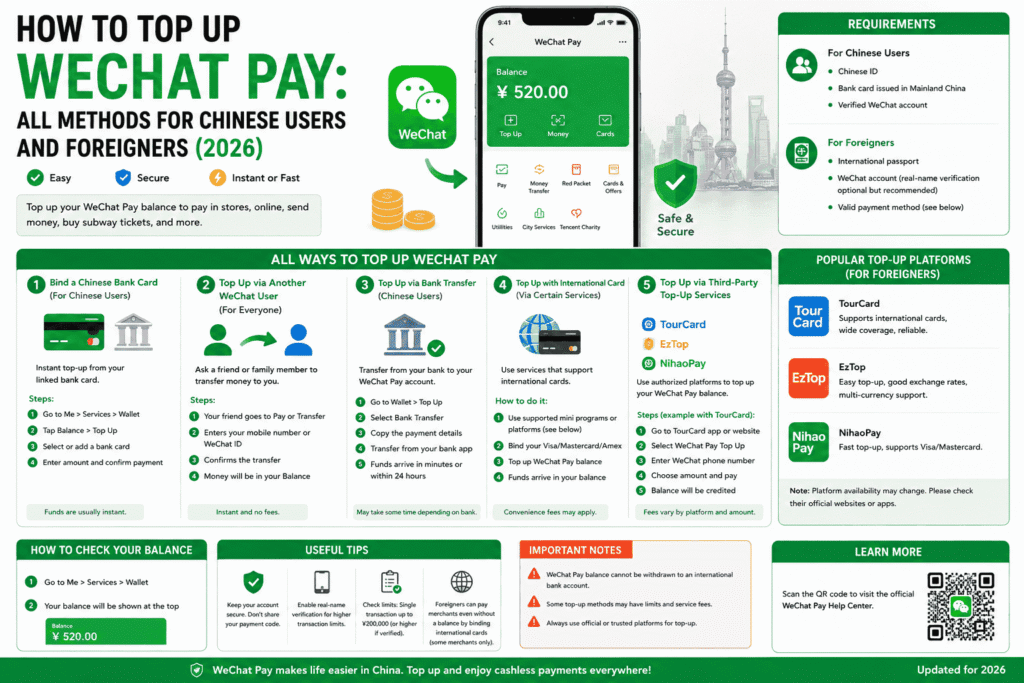
Before explaining top-up methods, it helps to clarify what “topping up WeChat Pay” actually means. WeChat Pay operates with two distinct payment pools:
WeChat Wallet (余额, balance): Money stored inside your WeChat account. You actively transfer funds here from a bank card or receive them via transfers/Red Packets. When you pay, the app draws from this balance first if enabled.
Linked bank/card payment: WeChat debits your linked card directly at the point of payment, without pre-loading. For Chinese bank cards, this is the default mode — money moves directly from your bank account at each transaction, without sitting in the WeChat wallet.
For foreigners with foreign Visa/Mastercard: WeChat can both pre-load the wallet and charge the card at payment time. Understanding which pool is being used determines your top-up approach.
2. Method 1: Top Up via Linked Chinese Bank Card
This is the primary method for Chinese users:
Step 1: Open WeChat → tap “Me” (我) in the bottom right → tap “Services” (服务) → tap “Wallet” (钱包).
Step 2: Tap the “+” icon or “Top Up” (充值) button.
Step 3: Select the linked bank card you wish to transfer from, enter the amount, and confirm with your payment password or biometric.
Limits: Single top-up: typically ¥50,000 (subject to card issuer limits). Top-ups are instant and free — there is no fee for loading your own balance from a linked card.
Note: This method requires your Chinese bank card to be already linked to WeChat Pay. If not yet linked, go to Me → Services → Wallet → Bank Cards → Add Card.
3. Method 2: Top Up WeChat Pay as a Foreigner (Foreign Visa/Mastercard)
Since 2023, WeChat Pay allows foreign card linking and topping up. The process:
Step 1: Ensure WeChat Pay is activated on your account. First-time activation requires phone number verification and a selfie check.
Step 2: Go to Me → Services → Wallet → Bank Cards → Add Bank Card → select “Overseas Card.”
Step 3: Enter your Visa or Mastercard details (card number, expiry, CVV) and the billing name exactly as it appears on the card.
Step 4: Once linked, top up via Me → Services → Wallet → Top Up, select your foreign card, enter amount in RMB (your card is charged in your home currency at WeChat’s conversion rate).
Troubleshooting: If your card is declined, your bank’s fraud prevention may be blocking the transaction. Call your bank before travelling to China and ask them to enable WeChat Pay / Tencent as a permitted merchant. Some banks require you to whitelist specific merchant category codes.
4. Method 3: Receive Money from a WeChat Contact
If a friend, family member, or business contact who uses WeChat Pay sends you a transfer, the funds land directly in your WeChat wallet. This is the fastest way to load your wallet when you have a Chinese contact who can help:
How to request a transfer: Open WeChat chat with the contact → tap “+” → “Transfer” (转账) → enter amount → send. The recipient receives a notification and the funds appear in their wallet immediately.
For tourists who have a Chinese host, guide, or business contact, asking them to forward funds (which you reimburse via Wise or bank transfer) is a practical workaround when foreign card top-ups are failing.
5. Method 4: WeChat Red Packets as Informal Top-Up
Receiving a WeChat Red Packet (红包) loads your WeChat wallet. If you are in a WeChat group with Chinese contacts — a common situation for business travellers and expats — group Red Packets during festivals or celebrations add small amounts that accumulate. This is not a primary top-up method, but it is a real source of wallet funds worth knowing about.
6. Method 5: UnionPay Cash Deposit at Bank ATMs
In China, certain bank ATMs support direct cash deposit to your WeChat wallet via UnionPay. This is relevant for users who receive RMB cash (from a currency exchange counter, for example) and want to load it to WeChat:
Step 1: Find an ATM that supports WeChat Pay loading (look for the WeChat Pay logo on the ATM screen or housing). Bank of China and ICBC ATMs in major cities frequently support this.
Step 2: Select “WeChat Pay Top-Up” from the ATM menu, enter your WeChat Pay registered phone number, insert cash, and confirm.
Availability: Not universal — this feature is more common in Tier 1 city branches. Do not rely on it being available without confirming at the specific ATM.
7. Method 6: WeChat Pay Merchant Cashback and Rewards
WeChat Pay periodically runs government-subsidised cashback campaigns (e.g., the “consumer voucher” schemes popular in Guangdong, Shanghai, and other major provinces). Spending via WeChat Pay during these campaigns returns a percentage (typically 10–20%) to your wallet. While not a top-up method per se, these campaigns are an important source of wallet balance for regular users worth tracking.
Chinese local governments have used these campaigns aggressively since 2020 to stimulate consumption. Watch for WeChat notification banners announcing new rounds, particularly during Golden Week holidays and Lunar New Year.
8. Top-Up Fees: What You Will (and Will Not) Be Charged
| Top-Up Method | WeChat Fee | Bank/Card Fee | Conversion Fee |
|---|---|---|---|
| Chinese debit card top-up | Free | Free | N/A |
| Foreign Visa/MC top-up | Free | Foreign transaction fee (0–3%) | ~1–1.5% (embedded in rate) |
| Contact transfer received | Free | Free | N/A |
| ATM cash deposit | Free | Free | N/A |
| Wallet withdrawal to bank | Free (up to ¥1,000/month); 0.1% above | Free | N/A |
The primary hidden cost for foreign users is the currency conversion rate applied when your foreign card is charged. WeChat does not publish this rate in advance — it uses Visa/Mastercard network rates plus a small additional margin. If you want to minimise conversion costs, load your WeChat wallet using a Wise multi-currency card: fund the card in RMB from Wise (converting at mid-market rate) and then use it as your WeChat Pay linked card.
Frequently Asked Questions
Q: How long does a WeChat Pay top-up take to appear?
A: Instant for Chinese bank card and contact transfers. Foreign card top-ups may show a 5–30 minute delay while the card charge is confirmed. ATM cash deposits are typically instant but can take up to 2 hours in rare cases.
Q: Can I top up WeChat Pay from a US bank account?
A: Not directly. Your US debit or credit card can be linked as a foreign card for top-ups within China. Direct US bank account linkage (ACH transfer) to WeChat Pay is not supported for international accounts.
Q: Why is my foreign card top-up being declined?
A: Most common causes: (1) Your bank is blocking the transaction — call and authorise WeChat/Tencent as a merchant; (2) The card is not Visa/Mastercard/JCB/Amex; (3) You have reached the annual ¥50,000 foreign card cap; (4) Your card’s own daily limits are exceeded. Work through each cause systematically.
Q: Is there a minimum top-up amount?
A: The minimum is ¥1 for both Chinese card and foreign card top-ups. In practice, top up at least ¥100 to avoid multiple small transactions triggering bank fraud alerts.
Conclusion: Have a Backup Method Always
The Australian tourist in Wanda Plaza needed exactly what this guide provides: knowledge of multiple top-up options so that when the primary method fails, a backup is immediately at hand. Link a foreign card, know how to accept a contact transfer as emergency top-up, and identify at least one ATM in your area that supports cash loading before you need it. WeChat Pay’s power is its ubiquity; your power is the preparation to keep it funded regardless of which specific top-up avenue works on any given day.