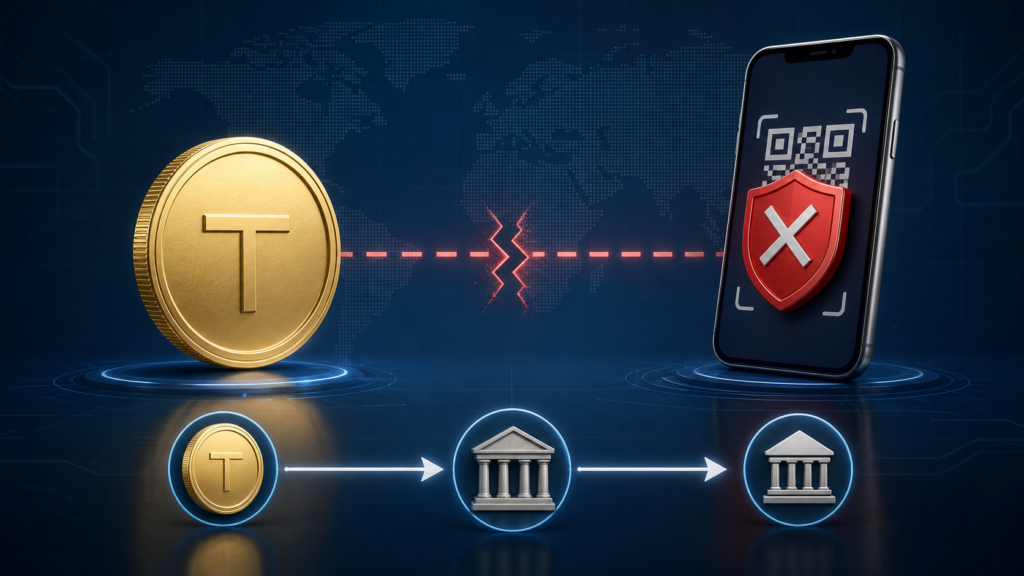
No, you cannot send USDT directly to Alipay. Alipay is a regulated fiat-payment service, not a cryptocurrency wallet, and it does not provide a USDT deposit address or an official USDT-to-CNY conversion feature. More importantly, using an Alipay account to settle a crypto trade can conflict with Alipay’s rules and mainland China’s restrictions on virtual-currency exchange.
If your real objective is to pay a person or supplier in China, the safer route is to convert the crypto through a regulated provider available in your jurisdiction, withdraw the fiat proceeds to a bank account in your own name, and then make a documented bank or licensed remittance transfer. Availability, tax treatment and reporting duties depend on your country.
Important: This is general payment-risk information, not legal, tax or investment advice. Do not use another person’s payment account, disguise a crypto sale as a purchase, or split transfers to avoid verification.
Can USDT be transferred to Alipay?
No. USDT moves between compatible blockchain addresses on networks such as Ethereum or Tron. Alipay records fiat payments within its payment network. An Alipay QR code is not a blockchain address, so sending USDT to it is technically impossible.
A website or trader advertising “USDT to Alipay” is normally offering a separate exchange: you transfer USDT to the trader, and the trader sends fiat to an Alipay account. That is not an Alipay feature or a direct transfer. It adds counterparty, fraud, account-freeze and regulatory risk.
Why is USDT-to-Alipay risky in mainland China?
The People’s Bank of China and nine other authorities stated in their September 2021 notice that virtual currencies—including Tether—do not have legal-tender status. The notice classifies fiat-to-virtual-currency exchange, virtual-currency exchange services, pricing and intermediary services as illegal financial activities. It also says overseas virtual-currency exchanges providing services online to mainland residents are engaged in illegal financial activity.
Alipay’s published cross-border service agreement separately lists trading or selling virtual currencies among prohibited transaction categories. It permits investigation, delayed settlement, suspension or termination where a transaction is suspected of money laundering, sanctions violations, foreign-exchange evasion or another breach.
| Claim or method | What it actually means | Risk |
|---|---|---|
| “Direct USDT to Alipay” | No native connection exists; a third party is exchanging crypto for fiat | High |
| P2P buyer pays your Alipay account | The Alipay transfer is settlement for a crypto trade | Account review or freeze, fraud and regulatory exposure |
| Payment sent to a supplier’s personal Alipay | A business payment may be mischaracterised as a personal transfer | Poor documentation, dispute and compliance risk |
| Crypto converted abroad, then documented bank transfer | Two separate, traceable transactions through providers permitted in their jurisdictions | Lower, but KYC, tax and transfer rules still apply |
Should you use a P2P trader who pays through Alipay?
For a mainland-China payment, we do not recommend it. Platform escrow may reduce the chance that one party disappears during the crypto leg, but it cannot make the fiat payment compliant, prove the source of the buyer’s money, or prevent a payment account from being reviewed later.
- Third-party-payment risk: the name sending the fiat may not match the verified crypto buyer.
- Source-of-funds risk: funds connected to fraud or money laundering can trigger investigation of downstream accounts.
- False-description risk: describing a crypto settlement as a purchase or personal payment creates an inaccurate record.
- Recovery risk: blockchain transfers are generally irreversible, while a fiat payment may be frozen or disputed.
- Supplier risk: paying a personal wallet leaves weaker commercial evidence than paying the contracting company named on the invoice.
What is the safer way to pay a Chinese supplier after selling USDT?
Use a traceable chain in which every account belongs to the correct person or business:
- Check your local rules. Confirm that selling USDT is permitted where you live and identify any tax or reporting obligation.
- Use an appropriately regulated provider. Confirm the provider serves your country and supports withdrawal to a bank account in your name. Do not assume a platform’s global brand makes every product available or regulated in your location.
- Keep the records. Retain trade confirmations, wallet transaction IDs, account statements and evidence of the source of the crypto.
- Withdraw to your own bank account. Avoid withdrawals to unrelated third parties.
- Obtain a supplier invoice and contract. The legal company name, bank beneficiary and commercial purpose should agree.
- Send through a bank or licensed remittance provider. Use the payment purpose requested by the provider and describe it truthfully.
- Reconcile the payment. Keep the transfer receipt and the supplier’s confirmation with the purchase file.
Wise states that eligible Business customers can send CNY to a mainland-China business recipient’s CNY business account. It requires recipient and payment-purpose details, and the recipient’s bank may request a contract and invoice. Eligibility, supported sending currencies and limits vary, so check the live route before relying on it. A conventional SWIFT transfer to the supplier’s company bank account may be more suitable when the invoice is denominated in USD or the remittance route is unavailable.
Before paying, review our guides to avoiding Chinese supplier-payment scams and converting USD to RMB. If the issue is an Alipay restriction rather than crypto conversion, see why Alipay payments fail and what to check.
Does a Hong Kong crypto account create a bridge to Alipay?
No. Hong Kong has a licensing regime for virtual-asset trading platforms, and the Securities and Futures Commission publishes the current licensed-platform list. A Hong Kong licence does not create an official USDT-to-Alipay rail, override mainland rules, or guarantee that a particular token, fiat withdrawal or customer type is supported.
A Hong Kong company may have legitimate banking and virtual-asset arrangements, but transfers into mainland China remain subject to banking, foreign-exchange, anti-money-laundering, tax and trade-document requirements. Forming a company solely to bypass payment controls is not a compliance solution. Businesses should obtain advice for their actual entities, jurisdictions and transaction purpose.
Options compared
| Route | Direct to Alipay? | Documentation quality | Extentage assessment |
|---|---|---|---|
| Send USDT to an Alipay QR code | No; technically unsupported | None | Do not attempt |
| P2P crypto sale settled to Alipay | No; third-party exchange | Weak and potentially misleading | Not recommended for mainland payments |
| Regulated crypto sale, own bank withdrawal, documented remittance | No | Strong if records and names match | Preferred general route, subject to local law |
| Direct bank or licensed remittance payment with no crypto leg | No | Strong | Simplest option for most supplier invoices |
Frequently asked questions
Is there an official USDT wallet inside Alipay?
No. Alipay does not provide users with a USDT deposit address or an official stablecoin-conversion feature.
Can a Chinese supplier legally request USDT?
Do not assume that a request makes the arrangement lawful. Ask which legal entity is contracting, invoicing and receiving the funds, and obtain transaction-specific legal and tax advice. A wallet address alone does not establish the correct beneficiary or provide normal trade-payment evidence.
Is USDT the same as digital yuan?
No. USDT is a privately issued token designed to track the US dollar. The digital yuan, or e-CNY, is central-bank digital currency issued by the People’s Bank of China. Read our digital yuan explainer for the practical differences.
Sources and review notes
- People’s Bank of China and nine authorities: Notice on virtual-currency transaction and speculation risks (24 September 2021).
- Alipay cross-border payment and settlement service agreement, including prohibited transactions and risk-control provisions.
- Hong Kong Securities and Futures Commission: current lists of virtual-asset trading platforms.
- Wise Help Centre: sending CNY to business recipients in mainland China.
Written by the Extentage editorial team. Fact-checked against the primary sources above on 1 August 2026. Policies, provider availability and account eligibility can change; verify the live terms before transacting.