An Alipay payment can stop just when you are ready to pay a supplier or complete a purchase. One particularly confusing message is 交易中断 / 收款方收款受限, commonly translated as “Transaction Interrupted / Recipient Receiving Restricted.”
The most useful detail is the word recipient. This particular message points first to the receiving account’s ability to accept the payment. It does not, by itself, mean your own Alipay account is blocked or your bank card is faulty.
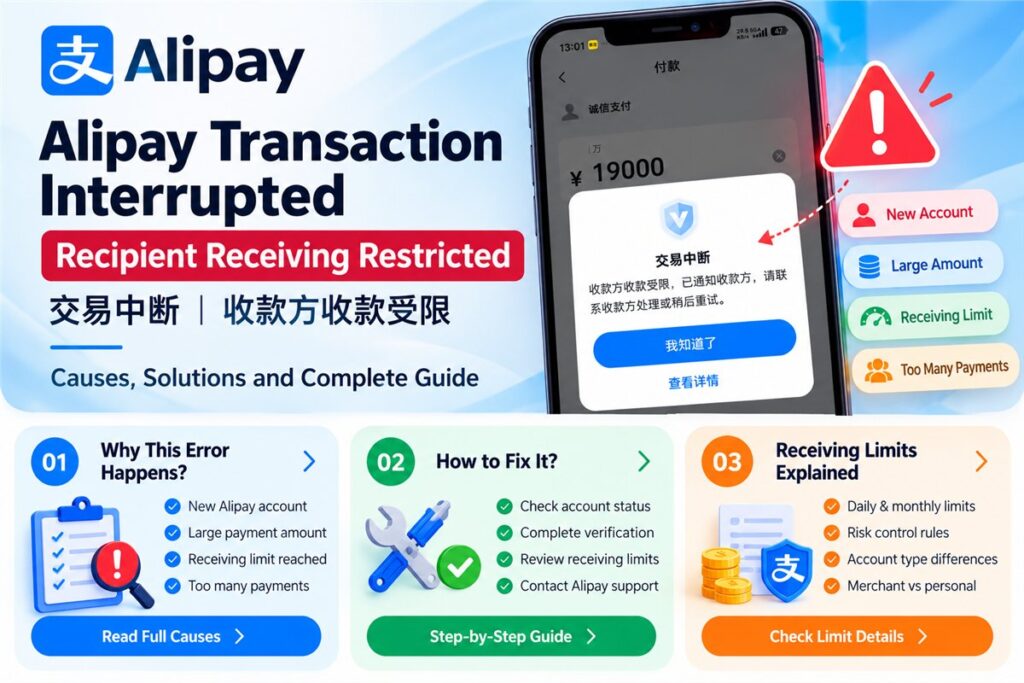
The screenshot below shows this error during an attempted ¥19,000 payment. Understanding its wording helps both parties decide what to check before trying again.
Why does Alipay say “Recipient Receiving Restricted”?
Alipay’s “收款方收款受限” message means the receiving account is currently unable to accept that payment. Possible causes include account-specific receiving limits, unusually large transactions, high payment frequency, incomplete verification, merchant-product restrictions or temporary Alipay risk controls. The recipient should check their account notifications and the “View Details” section for the exact reason.
The screenshot: what the Chinese Alipay error actually says

The popup reads:
交易中断
收款方收款受限,已通知收款方,请联系收款方处理或稍后重试。
In English:
Transaction Interrupted
“The recipient is currently restricted from receiving payments. The recipient has been notified. Please contact the recipient to resolve the issue or try again later.”
On smaller screens, swipe the table sideways to see all columns.
| Chinese text | English meaning |
|---|---|
| 我知道了 | Got it / I understand |
| 查看详情 | View details |
Key fact: “收款方收款受限” literally identifies a restriction affecting the recipient’s ability to receive that payment.
The screenshot does not establish that the recipient reached a daily limit, has a new account, committed wrongdoing or faces a permanent ban. It also does not prove that ¥19,000 caused the interruption. Those questions require the recipient’s account notice or an explanation from Alipay.
Readers searching for 支付宝收款受限 or 支付宝交易中断 should therefore start with the full error wording, rather than treating every interrupted payment as the same problem.
Is the problem with the sender or receiver?
For this exact message, start troubleshooting on the receiver’s account.

The recipient should open Alipay and check:
- Notifications and messages about receiving payments.
- Account or security-center warnings.
- Real-name verification status.
- Merchant services and collection settings.
- Available receiving limits, where displayed.
- Pending identity or business-information requests.
- Any restriction explanation or appeal instructions.
The sender should also open 查看详情 — View Details on the failed payment screen and share the explanation with the recipient.
Changing the sender’s phone or internet connection does not remove a restriction imposed on the receiving account. Repeatedly submitting the same payment also does not resolve missing recipient verification.
A separate funding problem can still exist. Alipay’s transfer help distinguishes balance-payment rules from bank-card limits and directs users to the checkout display for applicable card limits. These are sender-side payment limits, which should not be confused with an Alipay account receiving limit. Alipay Help: transfer-to-account limits.
If the wording on your screen is different, use the broader Alipay troubleshooting guide to identify the relevant issue. For card-funded commercial payments, also compare foreign-card supplier payment failures.
Why an Alipay recipient may be restricted from receiving money
The following explanations distinguish officially documented rules from practical scenarios. Alipay’s merchant agreements describe broader controls; they are not a diagnostic list proving why this particular popup appeared.

1. A new or recently activated receiving account
New receiving accounts deserve particular attention.
In the payment experience reported for this article, newly established recipients are a recurring setting for this error—especially when a substantial payment arrives soon after activation. This is a practical observation, not an Alipay rule stating that all new accounts fail.
A new account may have:
- Little transaction or receiving history.
- Limited evidence of its normal payment pattern.
- Incomplete identity or business information.
- A sudden increase in activity shortly after creation.
The practical inference is that a large or frequent incoming-payment pattern on a little-used account may warrant closer review. The official sources reviewed do not publish a universal account-age threshold, an approval formula or a guaranteed “safe” first payment.
What the recipient should do: Check whether onboarding and verification are complete, read any account notices and confirm that the intended collection service supports the transaction.
Do not create artificial transactions to “build trust.” Genuine account information and an appropriate payment product are more useful than attempts to manipulate an undisclosed risk assessment.
2. The payment is unusually large for the recipient
Consider a supplier who usually receives ¥1,000–¥3,000 but is now expecting ¥19,000. Or consider a recently activated account with almost no receiving history.
These are illustrative situations in which payment size deserves investigation. Neither example establishes a prohibited amount.
Alipay’s merchant product contract identifies transaction amount and consistency with the merchant’s operating scope and scale as relevant to abnormal-transaction monitoring. Alipay Product Service Contract, clause 3.2.7.
If an Alipay large payment failed, ask the recipient to check the stated reason before assuming there is a fixed ceiling. Record the amount, time and collection method so support can investigate the actual attempt.
There is no universal “safe amount” established by the screenshot.
3. An applicable receiving limit has been reached
An Alipay receiving limit may relate to a particular account, collection product or funding channel.
On smaller screens, swipe the table sideways to see all columns.
| Limit or condition | What to establish |
|---|---|
| Single-payment limit | Whether this individual payment exceeds the permitted amount |
| Daily receiving limit | Whether the relevant product has a daily allowance |
| Monthly usage limit | Whether a monthly condition actually applies to this service |
| Account-specific restriction | Whether the account has an individual limitation |
| Product or channel limit | Whether the restriction affects a particular QR service or payment method |
| Dynamic risk limit | Whether Alipay has adjusted receiving capacity following risk assessment |
Key fact: Alipay does not necessarily apply one universal receiving limit to every account. Its official 经营码, or business collection code, guidance explicitly describes risk-based dynamic collection limits. That guidance has a defined product and account scope; it is not a universal personal-transfer limit. Alipay business collection code guidance.
The exact limit shown for one account may not apply to another account. The recipient should check the limit or restriction shown inside their own Alipay account.
Do not assume every restriction resets at midnight or at the start of the next month. First establish whether the notice describes a periodic allowance, missing qualification or account review.
4. Too many payments received in a short period
A recipient may encounter trouble after many payments, even when no individual payment looks exceptionally large.
Practical scenarios worth investigating include:
- Many customers paying on the same day.
- Payments arriving from numerous unrelated payers.
- Rapid successive payments.
- A sudden increase in daily transaction count.
- Receiving substantially more payments than usual.
Key fact: Alipay’s published merchant contract describes monitoring transaction amount, number, type, timing, frequency and payer/payee information. It allows collection restrictions when activity appears inconsistent with the merchant’s business. Alipay Product Service Contract, clause 3.2.7.
This makes payment frequency relevant for suppliers and purchasing agents. It does not establish that a particular number of customers is automatically excessive.
What the recipient should do: Review incoming-payment records and the restriction notice. Explain genuine business growth or a busy trading period if Alipay requests supporting information.
Do not invent a fixed “maximum payments per day” from another user’s experience.
5. Real-name verification or business qualification needs attention
Receiving access can depend on identity verification and the qualifications required by the selected service.
Alipay’s longstanding real-name notice explicitly links unverified accounts with an inability to receive funds. Because that notice dates to 2014, recipients should use the current verification instructions shown in their own app rather than follow an old interface walkthrough. Alipay Help: real-name verification notice.
For merchant products, Ant Group’s Help Center separately describes qualification-dependent collection rules and restoring product use by completing required documentation. It states that actual review results and rules in force govern. Ant Group Help Center: payment-product limit rules.
Check for:
- Incomplete real-name authentication.
- A request for additional identity information.
- Missing merchant qualifications.
- Business-licence verification, where applicable.
- Inconsistent account-holder, business or address information.
A recipient should correct genuine discrepancies through the official process. Another person’s identity or unrelated business licence is not a substitute for the required qualification.
For help with the setup process, see our Alipay account setup and identity verification guide. Available features still depend on the recipient’s account and product.
6. Alipay risk control has restricted the transaction
Sometimes there is no simple “daily limit exceeded” explanation.
A sudden change in payment size, frequency or overall pattern can be a reason to investigate risk controls. Security concerns and suspected unauthorized activity may also be relevant.
Alipay’s internet payment agreement permits protective action when transactions appear abnormal or risky, including suspected unauthorized account or card use. Actions can include cancellation, holding funds or suspending services. Its provisions also allow restoration when Alipay determines the relevant risk has been removed or reasonably controlled. Alipay Internet Payment Service Agreement, clause 4.1.
An Alipay risk control restriction is not, by itself, evidence that the recipient committed fraud.
The useful question is: What explanation, evidence or account action does Alipay require? The popup alone cannot answer that.
7. The payment channel or account type has different conditions
“Receiving through Alipay” can describe several different arrangements. Understanding how Alipay QR payment models work helps identify which collection service is involved:
On smaller screens, swipe the table sideways to see all columns.
| Payment arrangement | What to check |
|---|---|
| Personal transfer | Recipient eligibility and transfer conditions |
| Merchant collection QR | Merchant approval and collection-product status |
| Website, app or business payment product | Contracted product and qualification requirements |
| Bank-card-funded payment | Supported funding channel and applicable card conditions |
| Huabei or credit-card collection | Whether the merchant supports that channel and whether it is restricted |
Alipay’s payment agreement contains specific risk provisions for credit-card, international-payment and Huabei collection services. This supports treating channel restrictions separately from an account-wide conclusion. Alipay Payment Service Agreement, section 9.
One payment method failing therefore does not automatically mean the entire account is permanently blocked. Equally, a different method should not be used to circumvent an unresolved restriction.
8. A temporary restriction or review requires action
The words “try again later” leave open the possibility that the condition is temporary. They do not provide a recovery deadline.
Depending on the notice, the recipient may need to:
- Complete requested verification.
- Submit business or transaction information.
- Resolve an account-security warning.
- Follow an appeal or review process.
- Wait until a stated restriction expires.
There is no supported basis here for promising recovery in two hours, 24 hours, three days or any other fixed period.
Waiting is appropriate when Alipay instructs the recipient to wait. It does not replace an outstanding request for documents.
Troubleshooting table: match the situation to the next step
These are diagnostic possibilities, not confirmed explanations for an individual account.
On smaller screens, swipe the table sideways to see all columns.
| Situation | Possible cause | What the recipient should do |
|---|---|---|
| New account + payment fails | Limited account history or incomplete verification | Complete verification and check Alipay notices |
| Small payments work but a large payment fails | Amount, risk or transaction limit | Check available receiving capacity and account notices |
| Account received many payments today | Transaction-frequency or risk control | Review notifications and receiving status |
| All incoming payments fail | Broader receiving restriction or account review | Check the account and contact Alipay support |
| Merchant QR has limitations | Merchant or product-specific condition | Check merchant collection settings and qualifications |
| Error appears only temporarily | Temporary risk or system control | Follow Alipay’s instructions and retry after resolution |
Use existing transaction history when assessing these patterns. Do not send repeated test payments to discover a hidden threshold.
How the recipient should resolve the restriction

Step 1: Read the detailed message
Open the relevant notification, restriction notice or View Details explanation. Save the exact wording and any reference number.
Identify whether it concerns identity, merchant qualification, a collection limit, security or transaction review.
Step 2: Identify the affected service
Establish whether the failed attempt used a personal transfer, merchant QR or another business product. Note the funding method if visible.
This prevents troubleshooting an unrelated service.
Step 3: Complete the requested account action
Submit only the information requested through Alipay’s official interface. Depending on the case, this may involve identity details, a valid licence or evidence explaining the transaction.
Follow the account’s current instructions; menu names and available options can differ.
Step 4: Contact official support if the reason remains unclear
Use Alipay’s in-app help/customer-service entry or the support route in the merchant backend.
A useful support request is:
“A payer sees 交易中断 / 收款方收款受限 when paying my account. Please confirm which receiving service is restricted, the reason, any required documents, and whether I need to submit an appeal or wait for a review.”
Provide the attempted amount, time, screenshot, collection method and transaction reference if one exists.
Step 5: Confirm resolution before requesting another payment
Ask whether receiving access has actually been restored. Do not rely only on the fact that the notification disappeared or a waiting period has passed.
What the sender should do when an Alipay supplier payment fails
The sender’s role is to document the failure, confirm payment status and let the recipient address the restriction.
- Save the error and View Details information.
- Check the transaction status before paying again. If the result is unclear, read Alipay transaction details and ask support to confirm it.
- Tell the supplier the error specifically names the recipient.
- Ask the supplier to check their own Alipay account.
- Retry only after the relevant issue is resolved or Alipay instructs you to do so.
If payment is urgent, discuss an authorized alternative appropriate to the purchase. Our guide to documented ways to pay Chinese suppliers explains the available approaches. Always verify supplier payment instructions, especially when beneficiary details change.
Do not split one prohibited or restricted transaction into multiple payments to evade Alipay limits or risk controls. Do not rotate through unrelated receiving accounts for that purpose.
How businesses and suppliers can reduce avoidable receiving problems
No account setup guarantees that every payment will be accepted. Businesses can nevertheless prepare for legitimate collection more effectively.
Use a suitable collection service. Before requesting substantial customer payments, confirm that the selected product fits the business and its expected payment activity.
Keep qualifications accurate. Alipay’s merchant service agreement requires relevant authorizations and business information and permits requests for additional documents. Alipay merchant service agreement, clause 2.1.
Retain evidence of genuine sales. Keep invoices, order details, delivery records and customer communications organized. Alipay’s merchant agreement expressly requires retention of transaction evidence. Alipay merchant service agreement, clause 2.5.
Prepare for changes in business activity. Before a new supplier account handles a major order or a significant increase in customer payments, review its approval status and discuss product suitability with support.
Monitor notices and protect account access. Assign responsibility for checking verification requests, security alerts and failed-payment reports. Do not share access with unrelated collectors.
These practices improve readiness to answer a review; they do not create immunity from risk controls.
Frequently asked questions
What does 交易中断 mean on Alipay?
It means “Transaction Interrupted.” Read the accompanying explanation to identify why the payment stopped.
What does 收款方收款受限 mean?
It means “Recipient receiving restricted.” The message identifies a restriction affecting the receiving party’s ability to accept that payment.
Why can’t my Alipay recipient receive money?
The popup alone does not identify the underlying cause. Ask the recipient to check their account notice and share the detailed explanation with Alipay support.
Can a new Alipay account receive a large RMB payment?
Account age alone does not establish eligibility. Before requesting a large payment, the recipient should confirm verification, collection-product status and any restrictions shown in the account.
Does Alipay have a daily receiving limit?
Check the specific collection product and account. Do not treat a daily allowance quoted for another service or recipient as your own limit.
Does Alipay have a monthly receiving limit?
Check whether a monthly condition applies to the service you are using. Do not confuse monthly card spending or sender-side payment limits with the recipient’s collection allowance.
Why can my recipient receive small payments but not a large payment?
That pattern is a useful diagnostic clue, not proof of a particular limit. Give Alipay the failed amount and existing transaction history rather than submitting repeated test payments.
Can receiving too many payments trigger an Alipay restriction?
Transaction frequency can be relevant to merchant risk assessment, but the reviewed documentation does not establish one universal number of incoming payments that causes a restriction.
How long does an Alipay receiving restriction last?
Use the timeframe in the recipient’s notice or support response. This error message alone supplies no recovery deadline.
Is an Alipay receiving restriction permanent?
The popup does not establish permanence. The recipient must check the restriction notice for its scope and any review or resolution process.
Can the sender fix a recipient receiving restriction?
The sender cannot complete the recipient’s account verification or review. They can provide the error details and cooperate with troubleshooting.
Should I try sending the payment repeatedly?
No. Check the original payment status and ask the recipient to investigate before another attempt.
Can the recipient contact Alipay support?
Yes. Use the official in-app customer-service entry or merchant support route, with the screenshot and attempted payment details ready.
Can a merchant Alipay account have different limits from a personal account?
Yes. Compare the actual collection services and qualifications involved rather than assuming the same allowance applies to both.
Why does Alipay show “try again later”?
It suggests a later attempt may be possible, but it does not explain the underlying restriction or promise automatic recovery. Read the account notice before retrying.
Research reviewed October 16, 2026. Official sources are linked beside the claims they support. Product-specific merchant rules are not presented as universal personal-account limits. Supporting infographics are editorial explanations, not Alipay app screens.