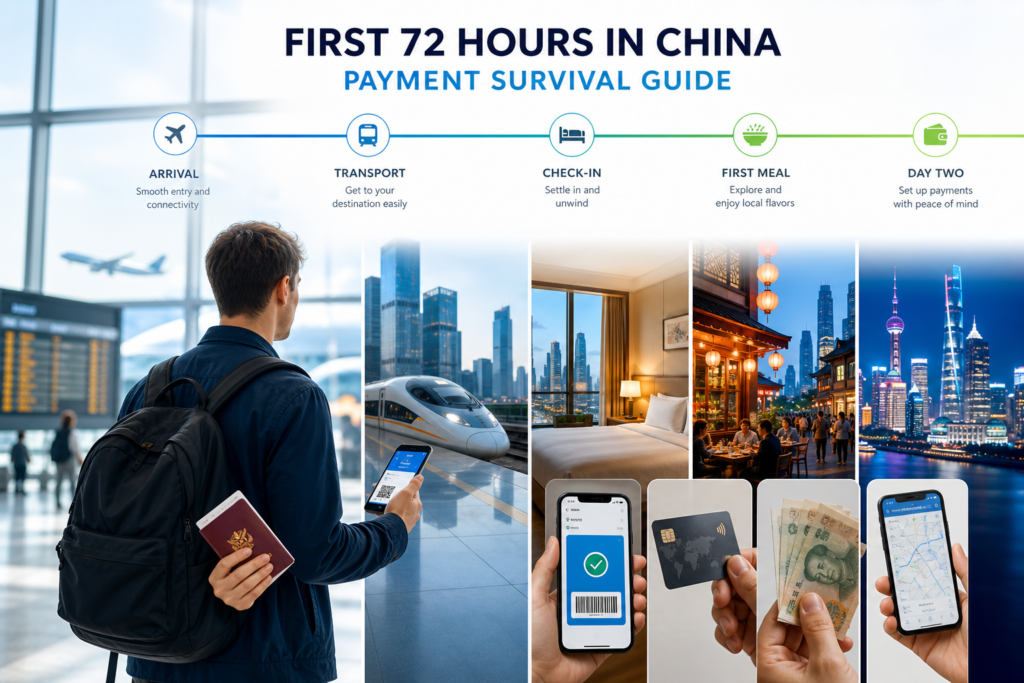
For your first 72 hours in China, prepare four payment layers before departure: a verified mobile wallet with an eligible card, a second international card from another issuer, a modest amount of RMB cash, and access to your home phone number for bank or wallet verification. Use official transport and hotel channels, confirm the displayed RMB amount before paying, and never assume one app, card, ATM, or merchant will work everywhere.
This timeline is for first-time visitors making ordinary travel purchases. A factory or supplier invoice requires a separate, documented business-payment process.
Before departure: complete this checklist
- Install the official Alipay and WeChat apps from your device’s app store.
- Register with a phone number you can access while in China.
- Complete truthful passport verification when requested.
- Link an eligible international card and complete issuer verification.
- Enable legitimate international purchases through your issuer.
- Save the issuer’s official international support number.
- Carry a second card from a different issuer or network.
- Arrange a reasonable RMB cash backup through a lawful exchange channel.
- Save your hotel name, address, and telephone number in Chinese.
- Download offline copies of bookings and essential addresses.
You can register Chinese payment apps with a foreign or Chinese number and bind supported overseas cards, but the issuer must authorize the connection. Product scope, limits, and fees vary. The official guide for foreigners is the best starting point.
Your four-layer arrival payment plan
| Layer | Use it for | Main limitation |
|---|---|---|
| Alipay or WeChat Pay with foreign card | Eligible merchant QR purchases | Issuer, merchant, wallet, and transaction must all support it |
| Physical international card | Hotels, airports, larger merchants displaying its network | Direct foreign-card acceptance is not universal |
| RMB cash | Backup for transport, small merchants, and outages | Change, security, ATM, and conversion considerations |
| Second issuer/payment method | Backup after a card decline or app restriction | Must be set up before it is urgently needed |
Hour 0–2: airport to accommodation
Connect before trying to pay
Confirm that your travel eSIM, roaming plan, or airport Wi-Fi provides working internet. A data-only eSIM will not receive ordinary SMS; keep your registered home SIM available if your bank sends codes there. Use the China eSIM and dual-SIM checklist.
Obtain RMB only through a supported channel
Official guidance says visitors can exchange currency at marked commercial-bank outlets, qualified money changers, and self-service machines, or withdraw RMB from ATMs displaying a compatible card-network logo. No named airport ATM is guaranteed to accept every foreign card, and airport exchange is not automatically cheaper.
Before confirming an ATM withdrawal, review the operator fee, issuer fee, exchange-rate treatment, and any home-currency conversion offer. Visa’s DCC guidance says both currencies, the rate, and additional markup should be disclosed and the customer must be able to accept or decline.
Choose airport transport you can document
Use the official taxi queue, airport rail, metro, hotel transfer, or a ride-hailing service booked through an official app. Confirm the destination and payment method before departure. China’s government guide says foreign travelers can use Alipay, WeChat, or Didi-Greater China for ride-hailing, and Didi supports foreign phone numbers and international cards.
Do not accept an unsolicited ride or transfer money to a stranger’s personal QR code. Keep your hotel address in Chinese for the driver.
Hour 2–12: hotel check-in and first meal
At the hotel
Present your passport and ask the hotel to explain the room charge, deposit, accepted card networks, authorization amount, and refund timing. A pending deposit can temporarily reduce available credit. Keep the receipt and compare the final posted amount later.
Official guidance lists RMB cash, bank cards, Alipay, and Weixin Pay as possible hotel methods but advises travelers to ask whether international networks are accepted. Availability remains property-specific.
At the first merchant
Use a genuine purchase to test your wallet. Confirm the merchant name, RMB amount, funding card, and any service fee before approving. Do not make repeated tiny transactions merely to test the system without the merchant’s agreement.
For a foreign-card QR payment, the published standard rule is no added wallet service fee when one transaction does not exceed RMB 200, and 3% of the full amount when it exceeds RMB 200. The draft’s claim that convenience stores are exempt was incorrect. Read the worked fee comparison.
Hour 12–24: stabilize transport and communications
- Verify that your registered phone number can still receive issuer messages.
- Add a backup card only through the official wallet.
- Enable the official transport code for the city if available.
- Save the hotel location and nearest metro station offline.
- Keep enough battery for payments and navigation; carry a compliant power bank.
- Review completed and pending wallet transactions before sleeping.
Metro options vary by city. Government guidance describes single-journey tickets, transport cards, cash, bank cards, and some app-based QR gates. Do not assume one transport code works in every city.
Day 2: test your backup and book onward travel
Test the second payment method on a legitimate purchase rather than waiting for an emergency. If a card declines, check the wallet message and issuer app before retrying. Contact the issuer through its official channel; do not send card details or SMS codes to the merchant.
For rail travel, foreign passport holders can use the official China Railway 12306 English website or app, complete identity verification online or at a station, and pay with supported Chinese or foreign cards or mobile payments. Your passport is the travel credential; the manuscript’s universal paper-ticket pickup instruction was outdated. Use the official 12306 English site.
Day 3: review what actually worked
| Question | Action |
|---|---|
| Which card linked and posted correctly? | Keep it primary; preserve a separate backup |
| Which merchants rejected foreign-card funding? | Use another accepted method; do not cycle personal codes |
| Were issuer fees or conversion unexpected? | Compare wallet receipt with final statement and card agreement |
| Did your home SIM receive verification? | Maintain access or arrange an issuer-approved alternative |
| Is your cash backup still appropriate? | Replenish through a lawful, transparent channel if needed |
If the statement differs from the receipt, follow the card-statement reconciliation guide. For ordinary app problems, use Alipay troubleshooting.
Seven mistakes to avoid
- Relying on one phone, wallet, or card.
- Waiting until the airport to complete every setup step.
- Assuming a network logo guarantees a particular card will work.
- Sending payment to an employee or driver’s personal code without understanding the recipient.
- Repeatedly retrying a payment without checking pending status.
- Artificially splitting a purchase to evade a fee, limit, or risk review.
- Assuming Beijing, Shanghai, a small city, and a rural destination have identical acceptance.
Supplier payments are outside this arrival plan
A travel wallet is mainly for eligible consumer purchases. If you arrive to inspect a factory or pay a vendor, verify the Chinese legal company, contract, invoice, beneficiary, currency, and charges. Use a business-capable route linked to the commercial documents. Start with how to send RMB to Chinese suppliers.
Frequently asked questions
How much cash should I carry?
There is no universal amount. Consider your destination, transport, accommodation deposit, risk tolerance, and storage security. Carry a modest backup in useful denominations rather than a large sum based on a blog’s fixed recommendation.
Is Alipay more reliable than WeChat Pay for every foreign card?
No authoritative evidence supports a universal winner. Card issuer, wallet verification, merchant, QR type, and transaction all matter. Preparing both can improve resilience.
Can a merchant refuse RMB cash?
China has promoted cash accessibility and includes cash in official visitor guidance. If a merchant cannot make change or a particular self-service context is involved, ask staff for an accessible alternative and retain another payment method.
What if my phone is lost?
Use another device to contact the mobile carrier, wallet, and card issuers through verified channels. Suspend relevant access and cards. Do not store payment PINs or full card details in passport photos.
Official sources and review note
- Guide to Working and Living in China (2025) — mobile payments, cash, cards, transport, hotels, and rail booking.
- Payment service guide for overseas visitors — diversified visitor-payment options.
- Government response on payment convenience — large payments by cards, small payments by QR, and cash as backup.
Written by the Extentage editorial team. Reviewed on August 2, 2026. Payment products, merchant acceptance, transport systems, and issuer rules can change; confirm live information before departure and at checkout.