Every year, more than half a million foreign buyers from 219 countries and regions walk through the gates of Yiwu International Trade City. They arrive with catalogues, spreadsheets, and ambitions: a Lagos trader hunting Christmas decorations; a Karachi importer filling shipping containers with stationery; a Lagos-based Amazon seller sampling LED lights. Yiwu is not the largest city in China — its population is under two million — but it is, without exaggeration, the world’s largest wholesale market for small commodities. This guide is the complete practical manual for first-time and returning importers.
1. What Is Yiwu International Trade City?
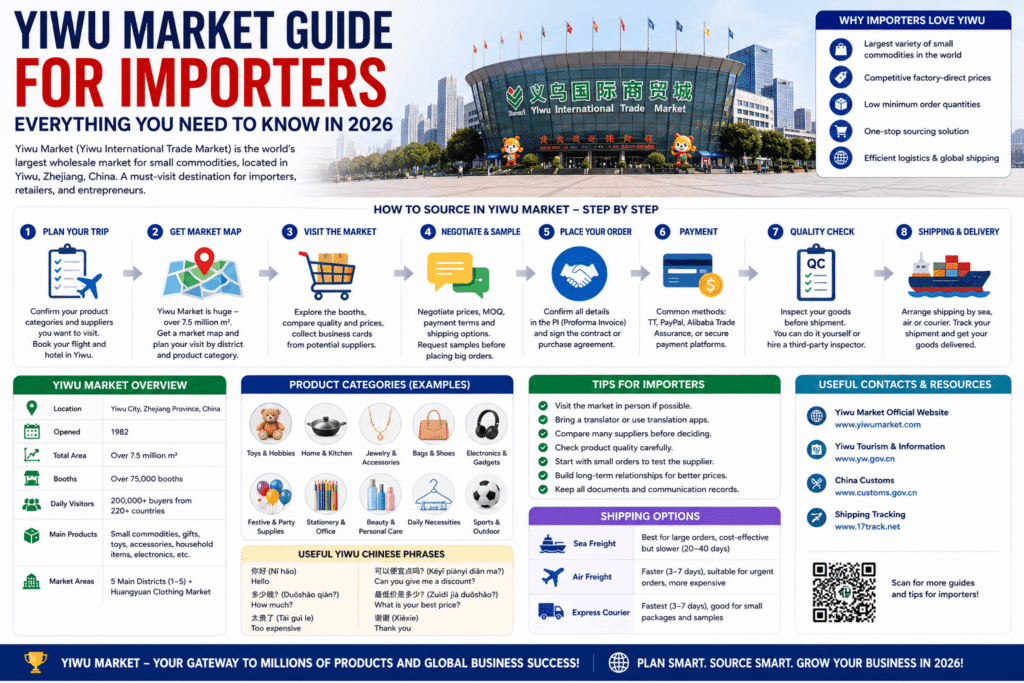
Yiwu International Trade City (义乌国际商贸城), locally known as the China Commodity City, spans five districts across approximately 5.5 million square metres of floor space. To contextualise that size: it is larger than 700 football pitches. It houses over 75,000 booths across categories including toys, stationery, hardware, jewellery, fashion accessories, artificial flowers, textiles, holiday decorations, and household items.
The market is not a single building — it is a complex of five interconnected mega-halls (Districts 1–5), each specialising in broad product categories. A typical first visit feels disorienting precisely because the scale defies normal navigational instincts. Experienced Yiwu importers plan their visits by district and category, not by wandering.
2. Getting to Yiwu
Yiwu has excellent transport connections for a mid-sized city, reflecting its status as a global trade hub:
By air: Yiwu Airport (YIW) serves domestic routes. For international arrivals, Shanghai Pudong (PVG) or Hangzhou Xiaoshan (HGH) airports are preferred entry points. From Hangzhou, the high-speed rail to Yiwu takes approximately 30 minutes. From Shanghai, 90 minutes by high-speed rail.
By high-speed rail: Yiwu Station is on the Shanghai–Kunming and Hangzhou–Shenzhen high-speed corridors. Direct or one-change services reach most major Chinese cities. Book via the 12306 app or Trip.com.
From the airport/station to the market: Taxi or Didi (China’s Uber) from Yiwu Station to International Trade City takes 10–15 minutes. Fare: approximately ¥15–25. The market is impossible to miss — it dominates the city’s geography.
3. Market Districts by Product Category
| District | Main Product Categories | Floors |
|---|---|---|
| District 1 | Jewellery, accessories, toys, gifts, artificial flowers, crafts, cosmetics | 4 |
| District 2 | Hardware, tools, electrical equipment, locks, auto accessories | 3 |
| District 3 | Luggage, bags, umbrellas, belts, garments, fabric accessories | 4 |
| District 4 | Socks, hosiery, underwear, gloves, hats, shoes | 3 |
| District 5 | Electronics, digital products, photography equipment, sporting goods, stationery | 5 |
Practical navigation tip: Use the official Yiwu Market app or Google Maps (enable offline maps before arriving) to navigate within districts. Each booth has a numbered address (e.g., 1F-1A-12345) — photograph booth addresses for every supplier you want to revisit, as you will not remember them from memory in a market of 75,000.
4. Minimum Order Quantities (MOQs) at Yiwu
Yiwu is a wholesale market — it is not designed for single-unit retail purchases. Understanding MOQs before visiting saves frustration:
Typical MOQs at Yiwu: Most suppliers have MOQs of 1 carton (一箱, yī xiāng). A carton might contain 12, 24, 48, or 120 units depending on the product. For small items (stationery, hair clips, keyrings), cartons are cheap — ¥50–200. For electronics or higher-value goods, carton values may reach ¥500–2,000.
Negotiating below MOQ for samples: Most suppliers will sell you 1–3 sample units at retail or slightly above wholesale price. Ask explicitly: “我想要样品” (Wǒ xiǎng yào yàngpǐn — I want samples). Sample purchases are standard practice and no supplier will refuse. Buying samples in Yiwu to test quality before placing full orders is the correct approach.
For custom products (printing, branding, colour changes): MOQs rise significantly — typically 200–1,000 units minimum for any customisation. Some suppliers have specific customisation MOQs printed on their booth information cards.
5. Pricing, Negotiation, and What Foreigner Pricing Looks Like
Yiwu suppliers are experienced with foreign buyers and have well-calibrated pricing strategies. Key realities:
First-quote prices are negotiable. Suppliers typically quote 20–40% above their actual floor price for first-time foreign buyers. Negotiation is expected and is not considered rude — it is part of the process. A polite “can you do a better price for a larger order?” is a standard opening.
Larger orders command better prices. The price for 100 cartons is meaningfully lower per unit than for 5 cartons. If your business model supports it, consolidating orders (buying multiple product types from fewer suppliers) increases your leverage.
Return buyer discounts are real. Suppliers track foreign buyers who return seasonally. Demonstrating that you are a reliable repeat customer — even showing photos of previous orders or mentioning that you have bought before — often unlocks better prices without hard negotiation.
Written quotes matter. Ask for a written price list (报价单, bàojià dān) before leaving a booth. Verbal prices change; written quotes at least establish a baseline for follow-up conversations.
6. Payment Methods at Yiwu
Understanding how to pay at Yiwu is critical — the market has its own payment ecosystem, and options for foreign buyers require advance preparation.
WeChat Pay and Alipay: Widely accepted by individual booth operators. For foreign buyers with foreign-card-linked WeChat Pay or Alipay International accounts, this works up to the account limits (¥50,000 annually). Suitable for sample purchases and small orders.
Cash RMB: Accepted everywhere. For foreign buyers, converting USD, EUR, or PKR to RMB at the Bank of China branch inside or adjacent to the Trade City is convenient. The Bank of China Yiwu branches are accustomed to large cash exchanges for trade purposes.
USD and other foreign currencies: Some experienced international-trade booths accept USD cash directly (particularly for large orders), applying their own exchange rate. Negotiate whether USD or CNY pricing is more favourable for your specific purchase.
Bank transfer (T/T — Telegraphic Transfer): The standard for large wholesale orders. Suppliers provide their company bank account details; you transfer from your home country bank. Typically a 30% deposit is required before production (for custom orders) and 70% before shipment. Wire transfer details should be verified carefully — Yiwu has a documented history of email interception fraud where fraudsters substitute bank details mid-negotiation.
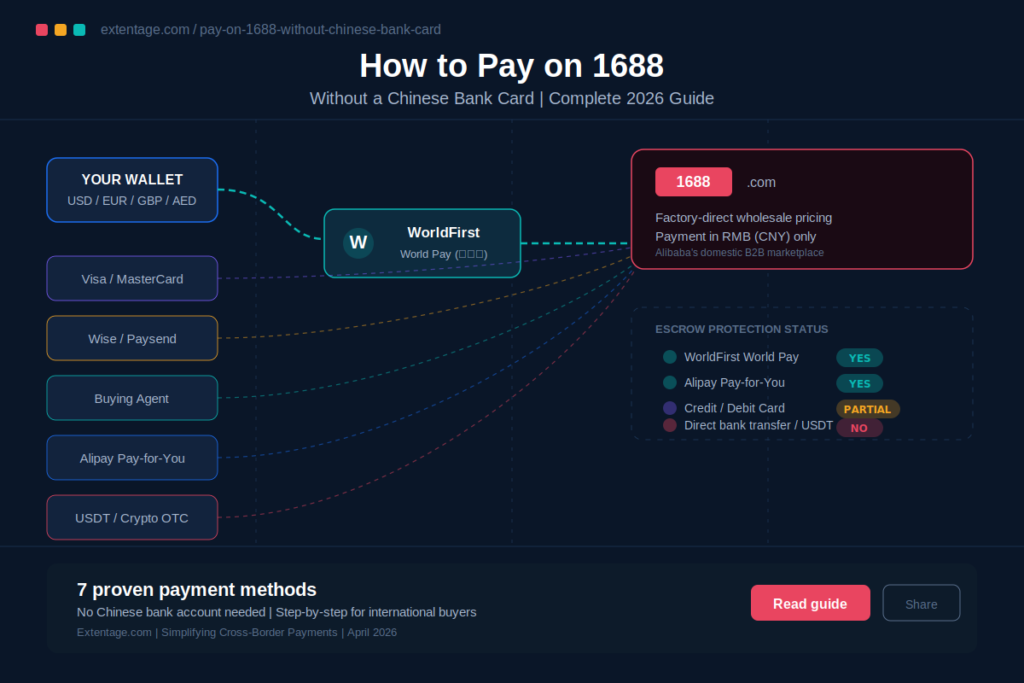
Alipay B2B (enterprise) and 1688 Pay: For orders placed through Alibaba’s domestic B2B platform (1688.com) sourced from Yiwu suppliers, 1688’s escrow payment system provides buyer protection. More complex to set up for foreigners but the gold standard for payment security.
7. Yiwu Agents: Should You Use One?
For first-time buyers and those without Mandarin Chinese, a Yiwu sourcing agent is a worthwhile investment. Agents navigate the market, translate, negotiate, consolidate orders, inspect quality, and arrange shipping from a single point of contact. Typical fees: USD 300–600 per day or a percentage of order value (3–8%).
Reputable agents are found through referrals from other importers, through trade shows (Canton Fair connections), or through verified agent directories. Be wary of agents who push you aggressively toward specific suppliers — a commission arrangement with the supplier undermines the agent’s objectivity.
For experienced importers returning on repeat trips with established supplier relationships, independent navigation is entirely practical — particularly with a translation app and pre-mapped booth addresses.
8. Shipping from Yiwu: Sea, Air, and Rail Options
Sea freight: The primary mode for commercial import volumes. Yiwu is approximately 280km from Ningbo Port (China’s second-largest container port) and 390km from Shanghai Port. A full container load (FCL) or less-than-container (LCL) can be arranged by any of Yiwu’s hundreds of freight forwarders. LCL transit to Pakistan: 25–35 days. To UK: 28–38 days. To Nigeria: 30–45 days.
China-Europe rail (Yiwu-London, Yiwu-Madrid train): Yiwu is the origin point of the world’s longest freight rail route — the Yiwu-London train (义新欧) which passes through Kazakhstan, Russia, Poland, Germany, France, and into the UK. Transit time: approximately 18 days. Cost: between air and sea. Valuable for time-sensitive or high-volume land-friendly goods.
Air freight: For samples, urgent small orders, and high-value goods. Yiwu Airport handles cargo; alternatively, goods truck to Hangzhou or Shanghai for air departure. Air freight to most destinations: 5–10 days. Cost: 4–8x sea freight per kg.
Frequently Asked Questions
Q: Do I need a business licence to buy at Yiwu?
A: No. The market is open to anyone who can travel to Yiwu. However, for importing goods into your home country, your customs authority may require an import licence or business registration depending on product category and volume. Check your country’s customs requirements before placing large orders.
Q: Is it safe to pay in cash at Yiwu?
A: For small purchases (samples, small orders under ¥5,000), cash is common and generally safe within the market. For larger orders, bank transfer with proper documentation is strongly preferred — cash disputes are difficult to resolve.
Q: What is the best time of year to visit Yiwu?
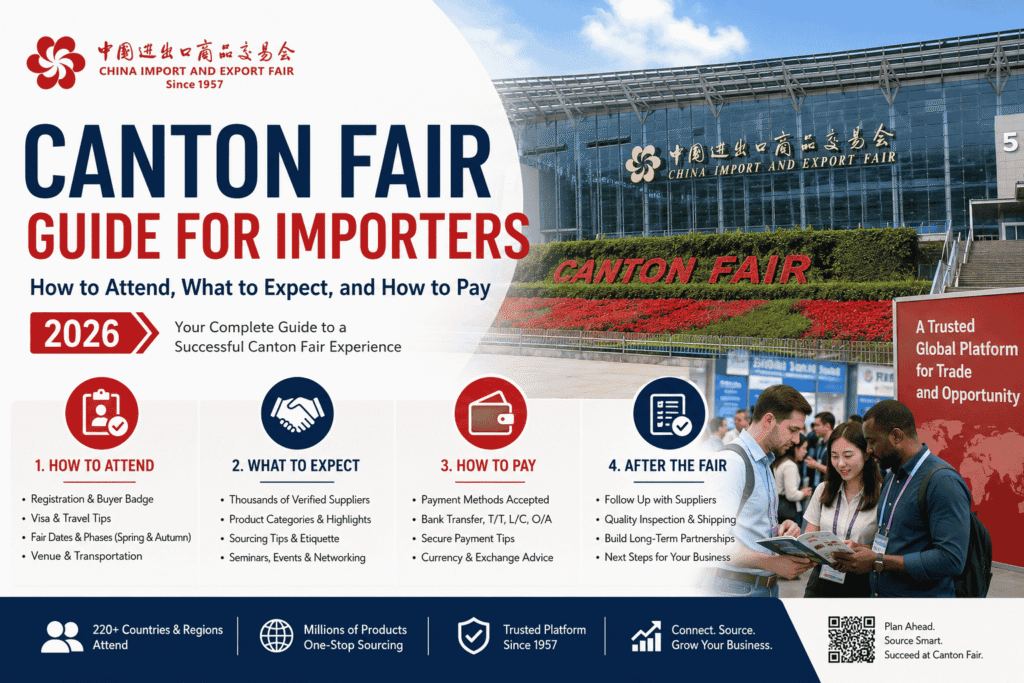
A: March–May and September–November are peak buying seasons, coinciding with Canton Fair dates when suppliers are in full production. Avoid January–February (Chinese New Year closures) and late July–August (extreme heat, reduced supplier availability).
Q: Can I order from Yiwu suppliers online without visiting?
A: Yes. Many Yiwu suppliers list on 1688.com (domestic B2B), Alibaba, and Global Sources. For custom orders and first-time relationships, an in-person visit remains the gold standard for quality assessment and relationship building.
Conclusion: Preparation Converts Overwhelm into Opportunity
Yiwu International Trade City is, for the unprepared, a sensory and logistical challenge of the first order. For the prepared importer — armed with a product list, a district map, an understanding of payment options, and realistic MOQ expectations — it is the single most efficient sourcing destination on earth. No catalogue, no website, no Alibaba listing substitutes for standing in front of 20 competing suppliers of the same product category and negotiating face-to-face against real samples. That is the enduring competitive advantage Yiwu offers to every importer willing to make the journey. Prepare. Arrive. And buy well.