Alipay and WeChat Pay use the same published service-fee rule for everyday merchant QR payments funded by an international card: no added platform fee when one transaction is RMB 200 or less, and a 3% service fee on the full amount when one transaction exceeds RMB 200. That makes neither app permanently cheaper on standard pricing. Your actual total can still differ because of a temporary promotion, the card you link, and fees or currency conversion applied by your card issuer.
This guide compares the cost layers a foreign visitor can verify before paying. It covers purchases, not transfers to individuals, wallet withdrawals, or commercial supplier invoices.
Alipay vs WeChat Pay fees at a glance
| Cost item | Alipay with an international card | WeChat Pay with an international card |
|---|---|---|
| Merchant payment of RMB 200 or less | No added platform service fee under the published visitor guidance | No added platform service fee under the published visitor guidance |
| Merchant payment above RMB 200 | 3% of the full transaction amount under the published visitor guidance | 3% of the full transaction amount under the published visitor guidance |
| Card issuer fee | Depends on your bank and card agreement | Depends on your bank and card agreement |
| Currency conversion | Depends on the card network and issuer terms shown for your card | Depends on the card network and issuer terms shown for your card |
| Promotional waiver | Check the live app before paying | May apply to eligible users; check the live app before paying |
| Permanent lower-cost winner | None on the standard published fee rule | |
The fee threshold applies to each transaction, not to your total daily or monthly spending. A purchase of exactly RMB 200 is within the no-platform-fee band described in the official guidance. A purchase of RMB 200.01 is above it.
How much does a payment actually cost?
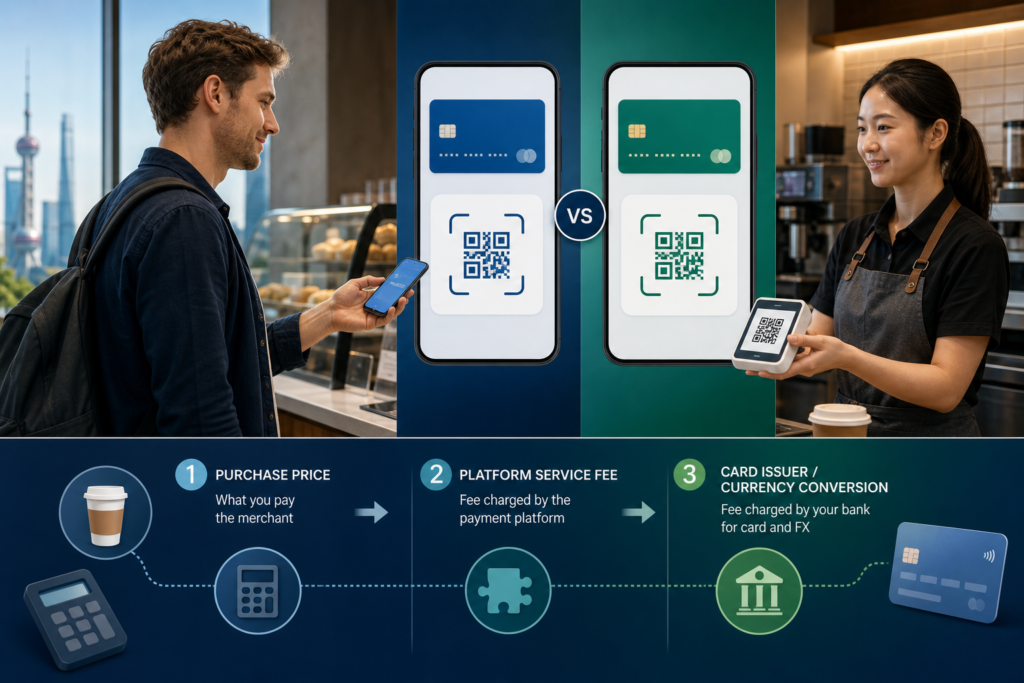
Think of a foreign-card mobile payment as three separate cost layers:
- Merchant price: the amount charged in renminbi.
- Wallet service fee: normally zero through RMB 200 and 3% above RMB 200 under the published international-card rule.
- Issuer and conversion costs: any foreign-transaction fee, exchange-rate treatment, or other charge in your card agreement.
Alipay or WeChat Pay can show the first two layers at checkout, but only your card issuer can explain the final amount that reaches your statement. Review your issuer’s current fee schedule before travel, especially if your card advertises rewards but charges for foreign transactions.
Worked example: RMB 180 purchase
For a qualifying RMB 180 merchant QR payment funded by an international card, the published platform service fee is RMB 0. The merchant charge remains RMB 180. Your issuer may then convert that amount into your billing currency and apply its own terms.
Worked example: RMB 500 purchase
If the standard 3% rule applies, the service fee is RMB 15:
RMB 500 × 3% = RMB 15
The wallet-side total is therefore RMB 515 before any issuer-side conversion or foreign-transaction charge. This calculation is the same for Alipay and WeChat Pay under the published standard rule.
Worked example: several purchases in one day
Suppose you pay RMB 60 for breakfast, RMB 180 for admission, and RMB 400 for dinner. The first two transactions fall within the no-platform-fee band. If no promotion applies, the RMB 400 dinner generates a RMB 12 service fee. The result is based on each payment separately, not the RMB 640 daily total.
Why your card statement may still be different
The absence of a wallet service fee does not necessarily mean the payment is cost-free. Your home bank may charge a foreign-transaction fee or use the conversion method specified in your card terms. A pending authorization can also differ from the final posted amount.
Do not assume a fixed 1%, 2%, or 3% bank markup without checking your own agreement. Issuers differ, and their terms can change. If the posted amount looks wrong, keep the in-app receipt and compare its RMB amount and wallet service fee with the final card statement. Article 4 in this series will provide a separate diagnostic process for statement discrepancies rather than duplicating this comparison.
For more exchange-rate context, see Extentage’s RMB versus USD exchange-rate guide.
Does WeChat Pay have a 2026 fee promotion?
Yes, but eligibility matters. Tencent announced that eligible first-time international-card users can receive a 90-day waiver of the 3% transaction fee for payments up to RMB 1,000 per day during its 2026 inbound-payment initiative. A promotion can make WeChat Pay cheaper for an eligible traveler during the offer period, but it does not replace the standard comparison for everyone.
Confirm activation, dates, daily limits, excluded transactions, and the fee shown on the payment screen. Do not choose an app solely from an old screenshot or third-party promotion summary. The Tencent 2026 announcement is the primary source for this offer.
Which app should a foreign visitor choose?
Install and verify both if possible. Because the standard fee structure is the same, the practical winner is the app that accepts your card, works with the merchant, and shows the better live offer. A second verified wallet also gives you a backup if one card authorization or merchant QR flow fails.
- Choose either app for purchases at or below RMB 200 when no special promotion changes the result.
- For a payment above RMB 200, compare the fee shown in both apps before confirming.
- If WeChat Pay shows an activated 2026 waiver for your account, verify that the purchase is within its terms.
- Use a card whose foreign-transaction and conversion terms you understand.
- Keep another lawful payment option available, such as a second international card or some RMB cash.
If features and acceptance matter more than fees, read the site’s broader Alipay versus WeChat Pay comparison. For setup help, use the Alipay account verification guide and review the current WeChat Pay limits guide.
Can you avoid the fee by splitting one purchase?
Do not treat payment splitting as an entitlement or a guaranteed fee-saving method. A merchant may decline multiple scans, its checkout system may not support them, and deliberately restructuring one purchase can create refund, receipt, or dispute problems. Ask the merchant before attempting multiple payments, and never pressure staff to alter a transaction.
For a legitimate larger purchase, compare the displayed wallet fee with direct card acceptance, cash, or another payment method the merchant supports. The cheapest lawful option depends on the merchant and your card terms.
This comparison does not cover supplier payments
Alipay and WeChat Pay linked to a foreign personal card are designed primarily for eligible consumer purchases. They are not a substitute for a documented business payment to a factory, vendor, sourcing agent, or wholesale supplier.
For a commercial invoice, verify the supplier’s legal name and bank details, agree on currency and fees, preserve the invoice and payment record, and use a compliant business-capable channel. Start with Extentage’s guide to sending RMB to Chinese suppliers.
Frequently asked questions
Is Alipay cheaper than WeChat Pay for foreigners?
Not under the standard published international-card fee rule. Both have no added platform service fee for a qualifying merchant payment of RMB 200 or less and charge 3% when the payment exceeds RMB 200. A live promotion or issuer-side charge can change your personal result.
Is the 3% charged only on the amount above RMB 200?
No. The official visitor guidance describes a 3% service fee based on the transaction amount once that single payment exceeds RMB 200. A RMB 500 payment therefore produces a RMB 15 service fee when the standard rule applies.
Does a zero wallet fee mean my bank charges nothing?
No. The wallet’s service fee and your issuer’s card or currency-conversion charges are separate. Check your card agreement and final statement.
Can an international card fund person-to-person transfers?
Do not assume it can. The international-card connection is primarily presented for eligible merchant consumption. Features such as transfers, red packets, balance withdrawals, and some mini-program transactions may be unavailable or require a mainland bank account.
Official sources and review note
- Ministry of Commerce guide for foreign businesspeople in China — international-card linking, merchant-payment fee threshold, and stated limits.
- Beijing government payment-services guide — card networks described as supported by Weixin Pay and Alipay.
- Tencent’s 2026 inbound-payment initiative — conditions summarized for the first-time-user waiver.
- Alipay international-card service information — official platform reference for linked overseas cards.
Written by the Extentage editorial team. Reviewed on August 2, 2026. Fees, eligibility, promotions, and issuer terms can change; confirm the amount shown in the app before authorizing payment.