A British English teacher accepting a position at a Chengdu high school faces a financial transition that no one fully prepares her for: within six weeks of arrival, she needs a Chinese bank account, a working Alipay, a functioning WeChat Pay, a method to send money home each month, and some understanding of why her Barclays debit card is categorically useless at 90% of the places she tries to use it. The domestic expatriate finance stack in China is a distinct ecosystem — parallel to but entirely separate from the Western financial infrastructure she grew up with. This guide builds that stack from scratch.
1. Priority One: Open a Chinese Bank Account
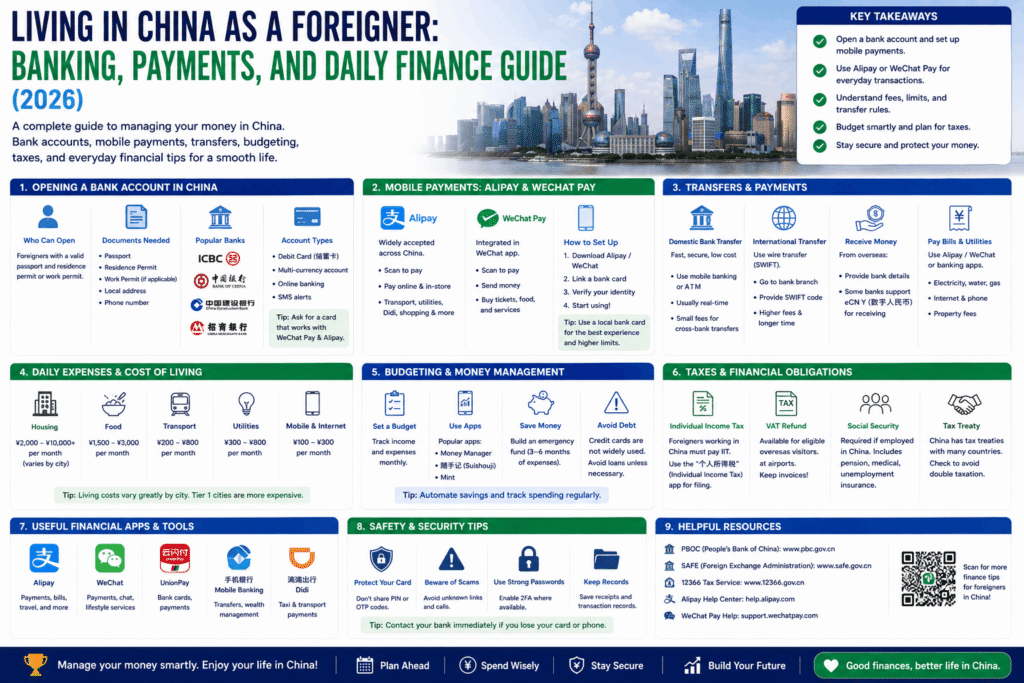
Opening a Chinese bank account is the single most important financial step for any foreigner staying in China beyond a tourist visit. Without it, you cannot receive salary, cannot fully activate Alipay or WeChat Pay, and are excluded from most domestic financial services.
Eligibility: Foreign nationals on work permits (居留许可), student visas, or business visas of 6+ months can open accounts at major Chinese commercial banks. Tourist visa holders face restrictions at most banks.
Best banks for foreigners:
- Bank of China (中国银行): The most internationally experienced and foreigner-friendly. English-speaking staff at many branches in major cities. Accepts the widest range of foreign documentation
- HSBC China: If you already bank with HSBC internationally, the global relationship is an advantage. Note that HSBC China is a separate legal entity from HSBC UK/HK — accounts do not automatically transfer, but the brand relationship facilitates introductions
- China Merchants Bank (招商银行): Popular with younger professionals and expatriates for its digital-first approach and well-designed app (One Card app has partial English interface)
- ICBC: The world’s largest bank — vast ATM network, reliable international services
What you need to bring:
- Valid passport (original, not a copy)
- Valid Chinese visa or residence permit
- Chinese phone number (you need a local SIM — get one at the airport on arrival)
- Initial deposit (typically ¥100–500)
- For some banks: employment contract or university admission letter
Process: Visit the branch in person during business hours. Take a number, wait, and be guided through the form-filling by a bank officer. The entire process takes 30–60 minutes. You leave with a debit card (储蓄卡) and a basic savings account. Online banking activation is done through the bank’s app using your registered phone number.
2. Activating Full Alipay and WeChat Pay
With a Chinese bank account and Chinese phone number, you can link your accounts to both Alipay and WeChat Pay for full domestic functionality:
Alipay full activation: Download Alipay → register with Chinese phone number → verify identity with passport → link Chinese bank card. Your spending limits upgrade from the foreign-card tier (¥50,000 annually) to the full domestic tier (effectively unlimited for standard consumer transactions).
WeChat Pay full activation: Open WeChat → Me → Services → WeChat Pay → activate → verify identity with passport and Chinese phone number → link Chinese bank card. Same upgrade: from limited foreign-card functionality to full domestic WeChat Pay capability.
Alipay Sesame Credit (芝麻信用): After 3–6 months of Alipay activity (purchases, transfers, bill payments), Alipay’s credit scoring system begins building a profile. A good Sesame Credit score unlocks interest-free instalment plans, deposit-free hotel bookings, and shared bicycle/scooter rentals without a deposit. It is China’s private credit score — behave financially as you would want a credit bureau to observe.
3. Receiving Your Salary in China
For employed foreigners, Chinese employers pay salaries directly to your Chinese bank account in CNY. The payment is made via domestic bank transfer on the employer’s standard payroll cycle.
Key financial points about receiving a Chinese salary:
Individual Income Tax (IIT): China taxes employment income on a progressive scale. Foreign employees are subject to IIT from their first month of employment. Your employer typically withholds and remits IIT on your behalf. Understanding your tax liability — and claiming applicable deductions (children’s education, rental housing expenses, continuing education, elderly parent care) — significantly affects net take-home.
Social insurance (社会保险): Depending on your residence permit type and employer’s structure, you may be enrolled in China’s social insurance system (pension, medical, unemployment, maternity, work injury). Contributions are split between employer and employee. Whether foreigners must participate varies by city — Beijing, Shanghai, and Guangzhou typically require foreign employee enrolment; some second-tier cities offer exemptions.
Tax residency implications: If you stay in China for 183+ days in a calendar year, China treats you as a tax resident for that year, potentially subjecting your global income to Chinese IIT. Consult a tax professional if you have significant income from outside China.
4. Sending Money Home from China
Remitting your savings home is a recurring need for most expatriates. The legal framework allows this within documented limits:
Standard process: Visit your Bank of China branch with passport, residence permit, employment contract, pay slips (for the transfer period), and IIT certificate (obtained from your employer’s HR or the local tax bureau app). Fill in the foreign exchange purchase form, specify the purpose (personal savings/salary remittance), and initiate the wire transfer to your overseas account.
Annual limit: USD 50,000 equivalent per person per calendar year without requiring SAFE approval. Most expatriate annual savings fit within this limit.
Timing: Many expatriates make one or two large transfers per year rather than monthly — the documentation process is the same regardless of frequency, and batching reduces the administrative burden.
IIT certificate (完税证明): This document from the Chinese tax authority proves you have paid tax on the income being remitted. Without it, banks above a certain threshold may refuse to process international remittances. Apply for it through the Individual Income Tax app or at the local tax bureau.
5. Everyday Finance: Bills, Utilities, and Subscriptions
Alipay and WeChat Pay handle almost everything in Chinese daily life:
- Electricity and water bills: Paid via Alipay or WeChat Pay through the utilities Mini Programs, or auto-deducted from your linked bank account
- Phone bills: Top up your China Mobile, China Unicom, or China Telecom number directly through Alipay or WeChat Pay
- Internet (broadband): Typically arranged through your landlord or building management; many properties include internet in rent
- Streaming services: iQiyi, Youku, Bilibili — all accept Alipay/WeChat Pay subscription payments
- Taobao/JD.com shopping: Linked Alipay or WeChat Pay account required; your Chinese bank card is the funding source
6. Insurance and Healthcare Payments
Healthcare payment in China follows a different model from most Western countries:
International hospitals: Major cities have international hospital wings (e.g., Parkway Health, United Family Healthcare, SinoUnited Health) that accept international health insurance and credit cards. Alipay and WeChat Pay are also accepted. These hospitals provide English-language care but at premium prices — a routine consultation runs ¥500–2,000.
Public hospitals: Used by most locally employed expatriates. Register via the hospital’s WeChat Mini Program, pay consultation fees (¥10–50 for most outpatient services) via WeChat Pay, collect prescriptions, and pay at the pharmacy counter via Alipay/WeChat Pay. The system is efficient once you know it — but entirely in Chinese.
Employer-provided health insurance: Many multinational employers provide supplementary health insurance covering international hospital access. Understand your policy’s claim process before you need it.
Frequently Asked Questions
Q: Can I keep my foreign bank account active while living in China?
A: Yes, and you should. Your home country account serves as the destination for China remittances, holds savings outside China, and maintains your credit history at home. Inform your home bank you are abroad to prevent fraud blocks on any transactions you initiate from China.
Q: Do I need to file taxes in my home country as well?
A: In most cases, yes. Citizens of the UK, USA, Australia, and most Western countries have worldwide income tax obligations regardless of where they live. The UK has a statutory residency test; the USA taxes citizens globally. Consult a cross-border tax specialist — many cities with expatriate populations have accountants experienced in dual-jurisdiction tax situations.
Q: What happens to my Chinese bank account when I leave China?
A: Dormant accounts are eventually closed or moved to dormant status by the bank, with minimal balance forfeited. Before leaving, withdraw remaining funds (or transfer internationally), formally close the account at the branch, and cancel any automatic payment mandates.
Conclusion: The Stack That Makes China Liveable
The British teacher who arrived with only a Barclays card and anxiety, and who leaves three years later able to navigate a public hospital registration, send money home with documentation precision, and file her IIT return via an app — that transformation is the practical result of building the right financial stack. Chinese bank account, linked Alipay, linked WeChat Pay, understanding of the remittance process, and basic IIT literacy: five components that together make everyday financial life in China not merely manageable but, in many respects, considerably more efficient than the cash-and-card systems she left behind. Build the stack in sequence, one component at a time, and China’s famously complex financial environment becomes something simpler: a parallel system that rewards preparation with frictionless daily life.