The exchange rate printed on the screen at the hotel currency counter looks wrong in the specific way that unfavourable exchange rates always look slightly wrong: not dramatically, not obviously fraudulent, just quietly different from what any internet currency converter would have shown five minutes earlier. The difference is approximately 3.5 percent, in the hotel’s favour, applied to a USD 2,000 exchange that the traveller needs for the first three days of a China business trip. That 3.5 percent represents USD 70 — enough for two good dinners, lost to the convenience of exchanging at the first counter encountered rather than the best counter available. Multiplied across every USD-to-RMB conversion on every China trip, this is not a trivial sum.
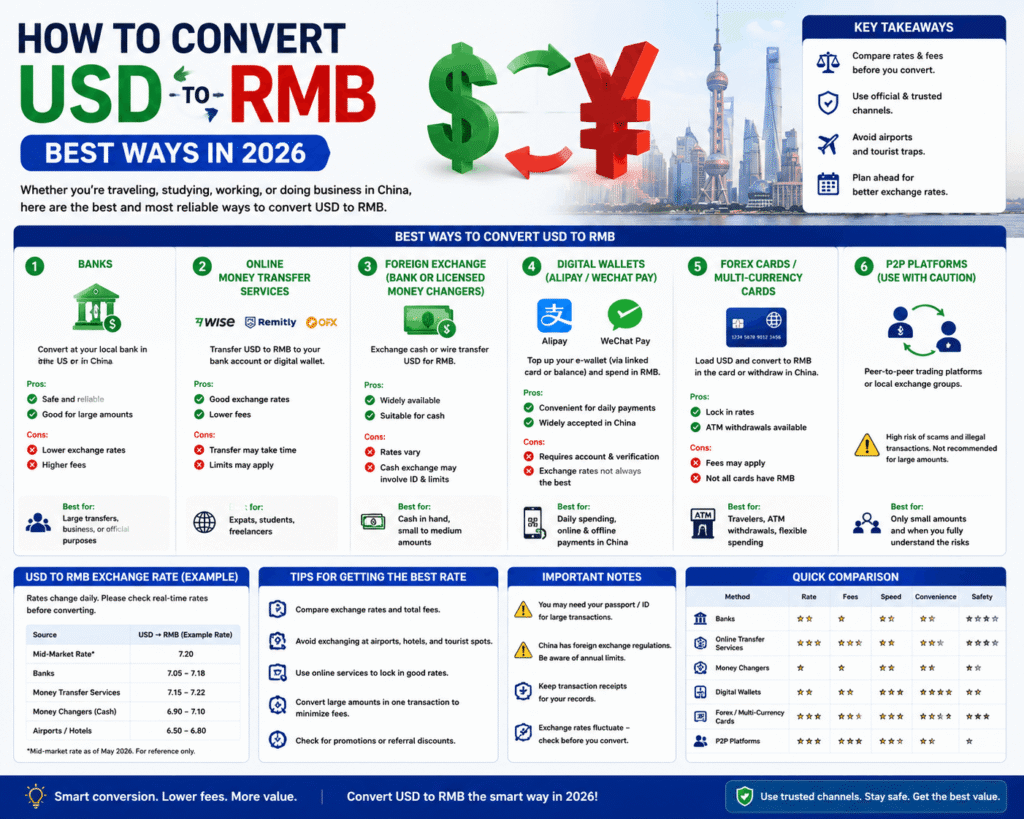
This guide maps every method for converting USD to RMB available in 2026, from the orthodox (US bank wire to China) to the efficient (Wise transfer) to the practical (Bank of China ATM on arrival), with honest figures for the cost and convenience of each. The argument is that the best USD-to-RMB conversion method depends entirely on purpose and context — and that understanding the options takes less time than losing money to a single uninformed exchange.
1. Understanding the USD/RMB Exchange Rate
The Chinese Yuan (Renminbi, RMB) has a managed floating exchange rate set within a band by the People’s Bank of China against a basket of currencies. The PBoC sets a daily midpoint rate (中间价, zhōngjiān jià) around which the onshore RMB (CNY) is allowed to trade within a ±2 percent band. The offshore RMB (CNH), traded in Hong Kong and other international markets, is slightly different from the onshore rate and is not subject to the same band restrictions.
For practical conversion purposes, the rate shown by Google, XE.com, and financial data services is the mid-market rate — the midpoint between the buy and sell price at which large institutions trade. This rate is unavailable to retail converters; every exchange method adds a margin above or below this rate that represents the service provider’s revenue. The size of that margin is the primary variable distinguishing the methods below.
2. Bank ATM in China: The Standard Arrival Method
The most practical method for travellers who need RMB cash on arrival in China is the Bank of China ATM. Bank of China ATMs at international airports accept Visa, Mastercard, UnionPay International, and most other international card networks. The exchange rate applied is the UnionPay or Visa/Mastercard network daily rate, which is typically within 0.5–1 percent of the mid-market rate. The Bank of China charges a withdrawal fee of approximately RMB 30–50 per transaction; the card issuer may add an international ATM fee of USD 3–5.
For a USD 500 withdrawal (approximately RMB 3,600 at 2026 rates), the total cost including the bank fee, card issuer fee, and 0.7 percent rate margin is approximately USD 10–15 — an effective conversion cost of 2–3 percent. This is not the cheapest method but is the most convenient for cash needs on arrival. Using a US card with no foreign ATM fees (Charles Schwab Investor Checking, Fidelity Cash Management, certain credit unions) eliminates the card issuer’s fee component and reduces the effective cost to the rate margin plus the Chinese bank fee only — approximately 1–1.5 percent.
3. Wise Transfer: Best for Large Bank Account Conversion
For converting large amounts of USD to RMB for delivery to a Chinese bank account — applicable to importers paying suppliers, businesses funding operations in China, or individuals transferring savings — Wise offers the best combination of rate and fee transparency. The mid-market rate is applied with a fee of 0.5–1.5 percent, displayed explicitly before confirmation. For a USD 10,000 transfer, the total cost via Wise is approximately USD 70–150 — considerably less than the USD 200–400 that a US bank wire would cost for the same amount.
Delivery is to a Chinese bank account (CNY) in 1–3 business days. Wise does not deliver directly to Alipay or WeChat Pay wallets.
4. Alipay Top-Up: Convenient for Payment Wallet Funding
For foreigners who need RMB in their Alipay wallet for in-China payments, topping up via a US Visa or Mastercard is the functional conversion method. Alipay applies a rate typically 0.5–1.5 percent above mid-market; the US card issuer adds a foreign transaction fee of 0–3.5 percent depending on the card. Using a no-foreign-transaction-fee card reduces the total conversion cost to Alipay’s margin alone. This method is effective for wallet funding amounts of USD 50–5,000; it is not a practical method for large USD-to-RMB conversions because the annual Alipay foreign card top-up ceiling (approximately RMB 100,000) constrains the total volume.
5. Currency Exchange at US Banks Before Departure
US banks (Chase, Bank of America, Wells Fargo) offer physical RMB banknote exchange for customers who wish to arrive in China with cash already converted. The exchange rates applied are typically 3–5 percent above the mid-market rate — significantly worse than the ATM-on-arrival method or Wise. The convenience of having physical RMB before landing rarely justifies the cost premium over a Bank of China ATM at the arrival airport. For the specific use case of having a small amount of RMB for airport transport and incidentals before finding an ATM, USD 100 converted at a US bank’s rate (effective cost approximately USD 3–5 over mid-market) is acceptable. Converting larger amounts at a US bank before departure is not economically justified given the alternatives.
6. Money Changers in China
Licensed currency exchange counters (外币兑换, wài bì duìhuàn) operated by banks and authorised exchange agents in Chinese hotels, shopping centres, and tourist areas offer USD-to-RMB exchange at rates set by the Bank of China’s official retail rate, plus the operator’s service margin. Hotel counters typically add 1–3 percent to the official rate; airport exchange counters outside bank branches similarly apply a retail premium. The most cost-effective option among physical exchange counters is a Bank of China or ICBC bank branch counter — these apply the official retail rate with minimal additional margin and represent the best rate for cash-to-cash physical exchange in China.
7. USD to RMB Conversion Summary
| Method | Effective Cost Above Mid-Market | Best For | Speed |
|---|---|---|---|
| Wise (USD to CNY bank transfer) | 0.5–1.5% | Large supplier/business payments | 1–3 days |
| Bank of China ATM (no-fee card) | ~1–1.5% | Cash needs on arrival | Instant |
| Alipay top-up (no-FX card) | ~0.5–1.5% | Wallet funding for in-China payments | Instant |
| Bank of China exchange counter | ~1–2% | Physical cash exchange in China | Instant |
| US bank (before departure) | 3–5% | Small cash amount before landing only | Instant (branch) |
| Hotel exchange counter | 3–5% | Emergency convenience only | Instant |
| Airport counter (non-bank) | 4–7% | Avoid except in emergencies | Instant |
Conclusion
Converting USD to RMB in 2026 is inexpensive when done correctly and expensive when done carelessly. The hotel currency counter — the default for the unprepared traveller — typically costs 3–5 percent above mid-market. The Bank of China ATM with a no-foreign-fee card costs approximately 1–1.5 percent. Wise for large commercial transfers costs 0.5–1.5 percent. The difference between the worst option and the best option on a USD 5,000 conversion is USD 100–200 — enough to fund several days of travel or to represent meaningful savings across a year of regular China payments. The instructions above make the best option for each use case explicit. What remains is only the habit of applying them.