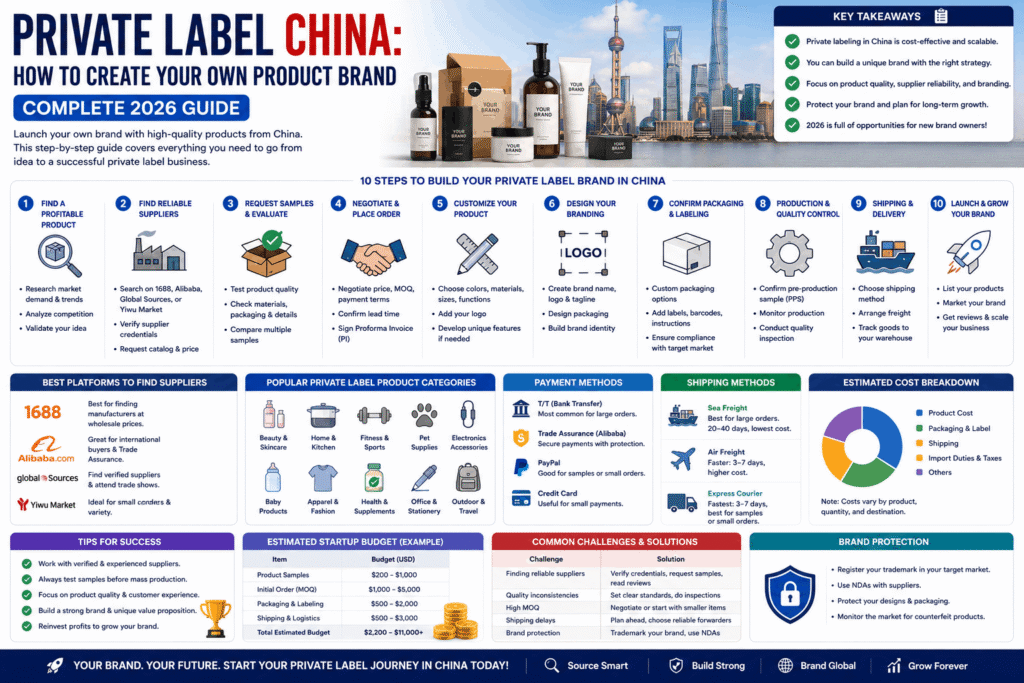
On the shelves of a Dubai hypermarket, a line of water bottles bears a confident logo — “AquaEdge” — with premium packaging and a competitive price point. They were conceived in a Sheffield apartment by a 26-year-old MBA graduate, designed on Canva, and manufactured in a Yiwu factory that also produces the exact same product under twelve other brand names for importers across six continents. This is private labelling: the business model that allows entrepreneurs without manufacturing infrastructure to create genuine branded products using China’s unmatched production capacity. This guide maps the complete pathway, from concept to finished goods, for any entrepreneur willing to learn it.
1. Private Label vs OEM vs ODM: Understanding the Terms
These three terms are often conflated but represent meaningfully different relationships with Chinese manufacturers:
Private Label: You source an existing product that the manufacturer already produces, apply your own branding (logo, packaging, colour scheme), and sell it as your own brand. The product design is not yours; the brand is. Lowest barrier to entry, fastest to market, minimal MOQs (typically 100–500 units).
OEM (Original Equipment Manufacturing): You provide the product specifications and design; the manufacturer builds it to your blueprint. Your design is proprietary; they do not sell the same product to competitors. Higher MOQs (typically 500–5,000+), longer lead times, but genuine product differentiation.
ODM (Original Design Manufacturing): The manufacturer owns both the design and the production capability. You licence their design and apply your branding. Similar to private label but with a formal design licence arrangement. Common in electronics, where manufacturers hold valuable design IP.
For most first-time brand builders, private label is the correct starting point: low capital risk, fast market test, minimal logistics complexity. Transition to OEM once you have validated product-market fit and can justify higher development investment.
2. Finding Private Label Manufacturers in China
The sourcing landscape for private label products in China spans multiple channels:
Alibaba.com: The starting point for most new importers. Search your product category + “private label” or “OEM/ODM” + “custom logo.” Filter by verified suppliers, Trade Assurance coverage, and minimum order quantity. Ideal for initial supplier discovery and quote comparison.
1688.com: For more competitive pricing, Chinese-language navigation to factory-grade suppliers. Image search is particularly powerful for finding manufacturers of specific products. Use in conjunction with a sourcing agent for payment and communication.
Global Sources: The professional alternative to Alibaba, particularly strong in electronics, hardware, and technology products. Annual Global Sources trade shows in Hong Kong connect serious buyers with verified manufacturers.
Canton Fair: The most efficient in-person source for private label suppliers — you can assess manufacturing quality physically, collect samples, and negotiate face-to-face with decision-makers. Essential for any serious brand builder.
Referral from existing importers: The most reliable channel. Factory recommendations from other entrepreneurs who have successfully used a manufacturer for private label work are worth far more than any platform listing. Industry forums (Reddit r/FulfillmentByAmazon, Jungle Scout community, SaleHoo forums) are valuable for referral sourcing.
3. Evaluating Private Label Manufacturers: What to Check
Factory audit: Before committing to an order, request a factory audit — either a third-party inspection (SGS, Bureau Veritas, Intertek) or a virtual factory tour via video call. The factory’s size, equipment, and workforce visibility tells you whether you are dealing with a genuine manufacturer or a trading company reselling another factory’s goods.
Sample order: Always order and pay for samples before placing a bulk order. Budget USD 50–300 for samples from 3–5 shortlisted suppliers. Evaluate not just the product but the supplier’s responsiveness, communication quality, and ability to execute custom requests (logo placement, colour modification).
Certifications relevant to your market: Products sold in the EU require CE marking for most categories; in the USA, products may require FCC, FDA, UL, or other certifications depending on category. Confirm with your target manufacturer whether they can provide the required certifications and request copies of existing certificates.
Production capacity and lead times: Confirm the factory’s capacity (units per day/month), standard production lead time for your MOQ, and how they handle peak seasons. A factory that cannot guarantee delivery timelines is a cash-flow risk for inventory-based businesses.
4. Packaging and Branding: The Mechanics
Your brand identity is what differentiates your private label product from the manufacturer’s generic version. Key components:
Logo design: Commission a professional designer (Fiverr, 99designs, Upwork) with clear vector file deliverables (.AI, .EPS, .SVG). Vector files are required for printing — JPEG/PNG from a phone screenshot is not acceptable for manufacturing use.
Packaging design: Specify dimensions, materials (cardboard, polybag, blister pack), print colours (CMYK values, Pantone codes), and all required text (ingredients, certifications, country of origin, barcode). Chinese packaging factories can produce to high quality; the limitation is usually the brief you provide them.
Barcode registration: If selling through retail channels or Amazon, you need GS1-registered barcodes (EAN-13 for international, UPC-A for North America). Purchase from GS1 directly (not resellers) for legitimate retail acceptance. Cost: varies by country membership fee structure.
Minimum packaging MOQ: Most Chinese packaging suppliers require minimum print runs of 500–2,000 units for custom packaging. This means your product MOQ is effectively set by whichever is higher: the product manufacturer’s minimum or the packaging supplier’s minimum.
5. Payment Structure for Private Label Orders
Private label orders follow a standard payment structure in Chinese manufacturing:
30% deposit on order confirmation: This covers raw material procurement and production initiation. Sent via T/T (bank transfer) or Alibaba Trade Assurance. Note: once materials are purchased for a custom order, the deposit is generally non-refundable if you cancel.
70% balance before shipment: Paid after you confirm the pre-shipment inspection (PSI) — your quality check before goods leave the factory. Never pay the balance before satisfactory inspection results. Use Alibaba Trade Assurance escrow where possible — funds are held until you confirm receipt and satisfaction.
Letter of Credit (L/C): For orders above USD 20,000–30,000, letters of credit through your bank provide an additional layer of protection. More complex to arrange but the industry standard for large commercial orders.
Alipay / WeChat Pay for samples: Small sample orders and deposit payments under ¥10,000 can often be paid via Alipay International or WeChat Pay foreign card accounts. Check with your supplier — many prefer bank transfer for auditing purposes even for small amounts.
6. Quality Control: The Step Most New Importers Skip
Pre-shipment inspection is not optional for private label businesses — it is the difference between a profitable launch and a returns catastrophe. Options:
Third-party inspection companies: SGS, Bureau Veritas, Intertek, QIMA, and Asia Inspection all offer pre-shipment inspections. Inspectors travel to the factory, examine a statistical sample of your production batch, and deliver a detailed report. Cost: USD 200–400 per inspection. Non-negotiable for first orders with new suppliers.
Your own sourcing agent: A China-based agent can conduct informal inspections as part of their service. Less rigorous than certified third-party inspection but better than nothing for trusted relationships.
Factory photos/video: For lower-value or lower-risk orders, requesting photo and video evidence of production batches before payment release is a basic quality gate. Not a substitute for proper inspection but relevant for repeat orders with verified suppliers.
7. Timeline from Concept to First Delivery
| Stage | Typical Duration |
|---|---|
| Supplier research and shortlisting | 1–2 weeks |
| Sample orders and evaluation | 2–4 weeks (including shipping) |
| Packaging design and approval | 2–3 weeks |
| Bulk production | 3–6 weeks (product-dependent) |
| Pre-shipment inspection | 1 week |
| Sea freight (China to destination) | 3–6 weeks (destination-dependent) |
| Total minimum timeline | 12–22 weeks (3–5 months) |
First-time importers routinely underestimate this timeline. Building in buffer at every stage is not pessimism — it is commercial realism. Launch campaigns, Amazon restocking schedules, and seasonal buying should be planned with 5-month lead times as the baseline assumption.
Frequently Asked Questions
Q: Can I start private labelling with no minimum order?
A: Some suppliers offer print-on-demand or dropshipping private label with zero MOQ, particularly through services like Printful, Printify (apparel/accessories) or AliExpress dropshipping. True factory-level private labelling requires minimum orders — typically 100–500 units. The lower the MOQ, the closer to retail pricing you will pay.
Q: How do I protect my design from being copied by the manufacturer?
A: File a trademark in your target market (not just China) before placing orders. Consider registering your design in China through CNIPA if your volume justifies it. Use NNN agreements (Non-disclosure, Non-use, Non-circumvention — the Chinese law equivalent of NDAs) before sharing detailed specifications. No protection is absolute, but documented legal registration deters the most opportunistic copying.
Q: Is there a minimum investment to start a private label business from China?
A: Practically, a serious first private label launch requires USD 2,000–5,000 minimum: samples (USD 200–500), packaging design (USD 200–500), first bulk order deposit (USD 1,000–3,000), inspection (USD 200–400), and logistics (USD 300–600 for air freight on initial stock). Sea freight reduces logistics cost but increases time.
Conclusion: The Factory Is the Equal Opportunity Engine
The AquaEdge water bottle sitting in a Dubai hypermarket represents a democratisation of manufacturing that would have been structurally impossible before the internet and China’s export infrastructure matured together. A Sheffield apartment and a laptop are, today, sufficient to build a branded physical goods business at competitive global price points. The factory in Yiwu does not ask about your age, your nationality, your capital structure, or your pedigree. It asks about your specifications, your quantity, and your timeline. Know those three things with precision, manage your payments carefully, inspect before you pay the balance, and the private label opportunity is as available to you as to anyone. That is the factory’s enduring promise.